Plinko looks like the easiest game in a crypto casino. There is one button, one falling ball, and a row of numbers at the bottom. The simplicity hides a handful of decisions that quietly shape every session, and beginners tend to get the same ones wrong.
Most of the mistakes are not about luck at all. They come from misreading what the board shows or from habits that grow when rounds last only a few seconds.
Starting With The Wrong Stake
The first mistake happens before the ball drops. Many newcomers pick a stake because it feels small, without asking how many drops it buys. A stake that looks harmless can empty a budget in a few minutes when rounds take two seconds each.
A better method works backward from the budget. Anyone ready to play plinko with real money should decide how many drops the session should include, say one hundred, and divide the budget by that number. The result is the stake, and it keeps a bad streak from ending the session before it has had time to even out.
The same logic applies to raising the stake after a win. A larger bet turns a normal swing into a serious one, and the extra money at risk is often the money that was just won.
Automatic play makes this worse. When a bet repeats without a click, the player stops making decisions, and a stake chosen carefully at the start can burn through the budget while attention is elsewhere.
Expecting The Ball To Even Things Out
After ten drops without a large payout, many players feel that the next one is due. This belief is known as the gambler's fallacy: the mistaken idea that an event which has happened less often than expected becomes more likely in the future. The error applies whenever the events are independent.
Every drop in Plinko is independent. The ball does not remember the previous result, and each peg sends it left or right with the same chance regardless of what happened before. A long stretch without an edge slot does not push the next drop toward the edge.
The opposite habit causes trouble as well. Some players believe that a run of good results means the board is hot, and they raise their stakes to ride it. The probabilities are the same before and after any streak.
The practical remedy is to judge a session by its plan and not by its recent history. If the plan called for a hundred drops at a fixed stake, the next drop is simply one of the hundred.
Misreading The Multiplier Row
The numbers at the bottom of the board look like a menu of prizes, but they are better read as a trade. The big multipliers sit on the edges because the ball rarely gets there, and the middle slots, where it usually lands, often pay less than the stake.
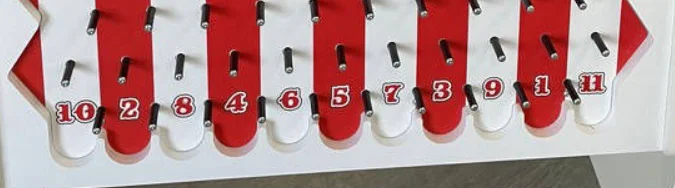
The numbers show it clearly. On a board with eight rows, the center slot catches about 27 percent of drops and each edge slot about 0.4 percent. On sixteen rows, the center falls to about 20 percent and an edge slot to roughly one in 65,000.
A beginner who aims for the edges is therefore betting on uncommon landings, and going many drops with no big payout is the normal result. Whichever risk level is chosen, the house takes roughly the same share of each unit staked, because the multipliers are set to give the house its margin across all outcomes.
Reading the row from the center outward helps. Note which slots pay less than the stake, which pay roughly the stake and which pay more, then estimate how often the ball lands in each group. Most beginners are surprised by how large the losing group is.
Ignoring Risk Level and Row Count
Two settings control how rough a session feels. Row count decides how widely the ball can scatter, and risk level decides how steeply payouts rise toward the edges. A high risk setting with many rows is the most volatile combination, and it is a poor fit for a small budget.
Beginners often switch to the highest risk setting after a few losses, hoping one big drop will recover everything. Chasing losses this way raises both the size of the swings and the chance of finishing the session empty.
A calmer approach is to choose a medium setting and keep it for the whole session. Consistency makes results easier to review, and it prevents the settings from turning into a way of gambling harder.
Some platforms let the player preview the multiplier row for each risk level. Comparing the rows side by side before the session, and noting how low the central payouts fall at the higher levels, makes the cost of the choice visible.
Trying a handful of low-stake drops at a new setting is also sensible. A short test shows how the ball behaves and how fast the balance moves, and it costs little.
Habits Worth Building From The First Session
A few small habits prevent most of the damage.
Set the budget and the number of drops before the first ball
Keep one risk level and one row count for the whole session
Stop when the planned number of drops is done, win or lose
Never reuse money meant for bills, rent, or savings
Take a break after every block of fifty drops
Record the result of each session, including the losses
Habit number one matters most, because the rest depend on it. A written budget is a promise made by a calm version of the player to the version who is mid-session, and it is far easier to keep when the amount and the number of drops are fixed in advance.
Play With A Plan, Not A Hunch
Plinko is simple to play, but that simplicity is exactly why beginners slip. Most of the common mistakes come down to the same thing: letting the speed of the game replace decisions that should have been made beforehand. A stake chosen without counting drops, a belief that a payout is due, a misread multiplier row, and a risk level raised in frustration all grow from playing on impulse.
The fix is mostly preparation. Set the budget, divide it into a fixed number of drops, pick one risk level and row count, and stop when the plan is done. None of this changes the odds, because the odds belong to the board. What it changes is how the session feels and how much control stays with the player.
Treat every session as paid entertainment with a known cost, and walk away when the plan says so.