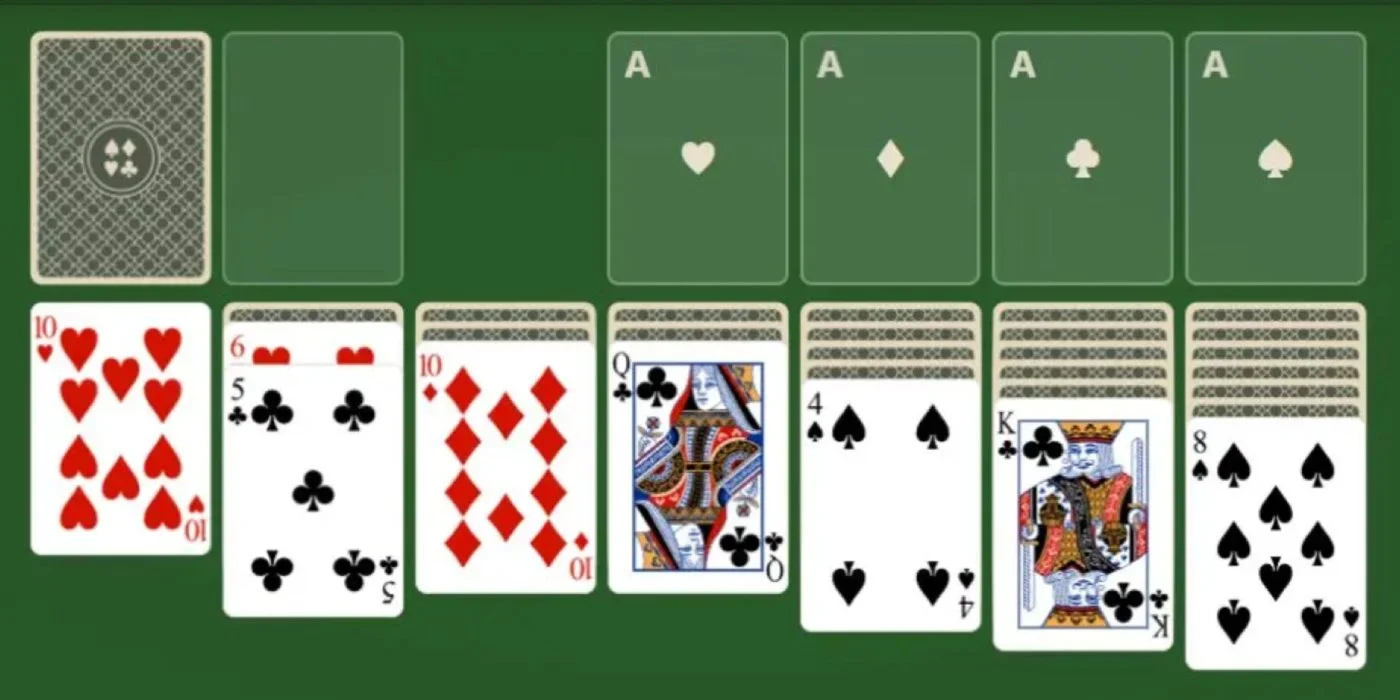
A useful opening move in Klondike does more than put two cards in the right order. It changes what you can see. That distinction is easy to miss when the board offers a legal move and your hand reaches for the stock instead. A new card sounds promising, but there may already be information waiting under a tableau column.
The position below comes from a Draw 1 game on PlaySolitaire. Moving the five of clubs onto the six of hearts uncovers a queen. It is a small example, but it gives us a concrete way to examine solitaire strategy: identify the legal move, check what it reveals, then reassess the board before acting again.
Read the seven exposed cards first
In the first image, the exposed tableau cards are the ten of hearts, six of hearts, ten of diamonds, five of clubs, four of spades, king of clubs and eight of spades. The foundations are empty and the stock has not been drawn. There is no need to guess which hidden card will appear to spot an available move.
The black five can move onto the red six because tableau sequences descend one rank and alternate colors. The four of spades cannot go onto the five of clubs: consecutive ranks alone are not enough. Both cards are black. Checking rank and color separately is quicker than trying each card on every pile.
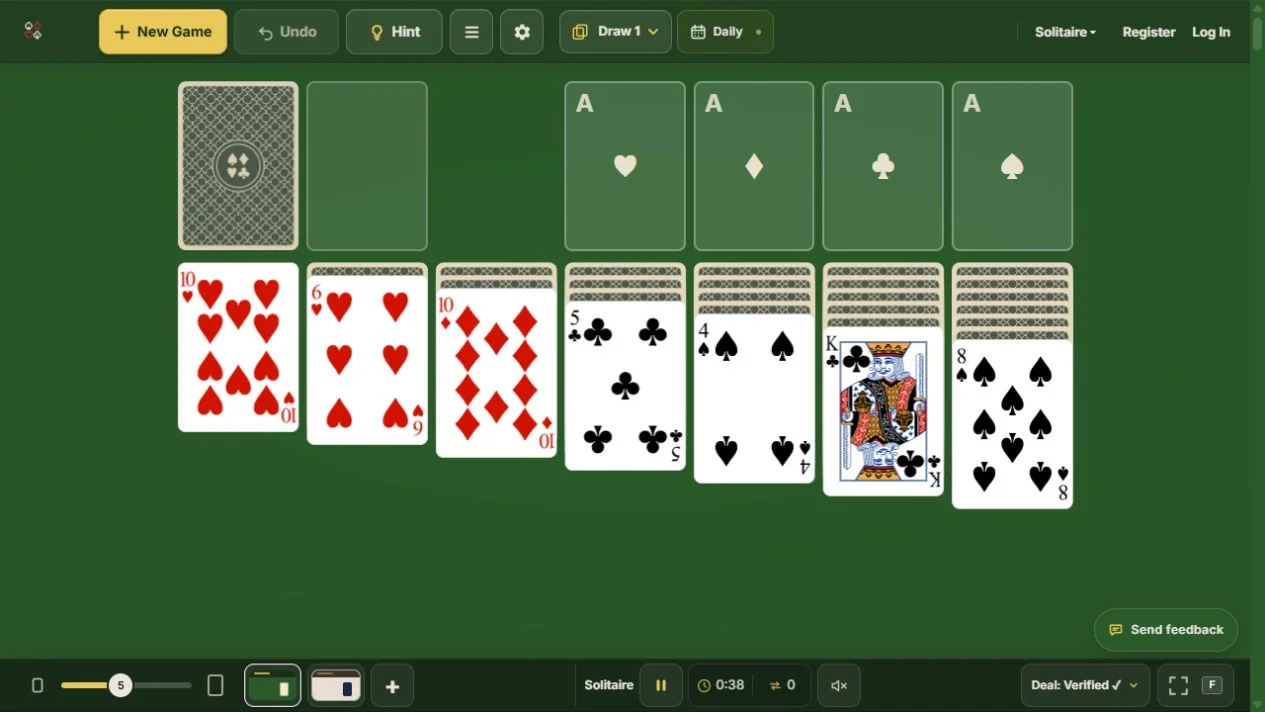
Before the move. The five of clubs in the fourth column can go onto the six of hearts in the second. Original gameplay screenshot captured on PlaySolitaire.io.
Notice what the move actually changes
After the five moves, the queen of clubs underneath turns face up. The second column now ends with a six and five, while the fourth has a newly exposed queen. One hidden card has become usable information without drawing from the stock.
That does not mean the queen immediately has a destination. The visible king is also a club, so putting the queen on it would break the alternating color rule. The move still gave us something useful: we now know that this column needs access to a red king before that queen can move away. Revealing a card and immediately playing that card are different kinds of progress.
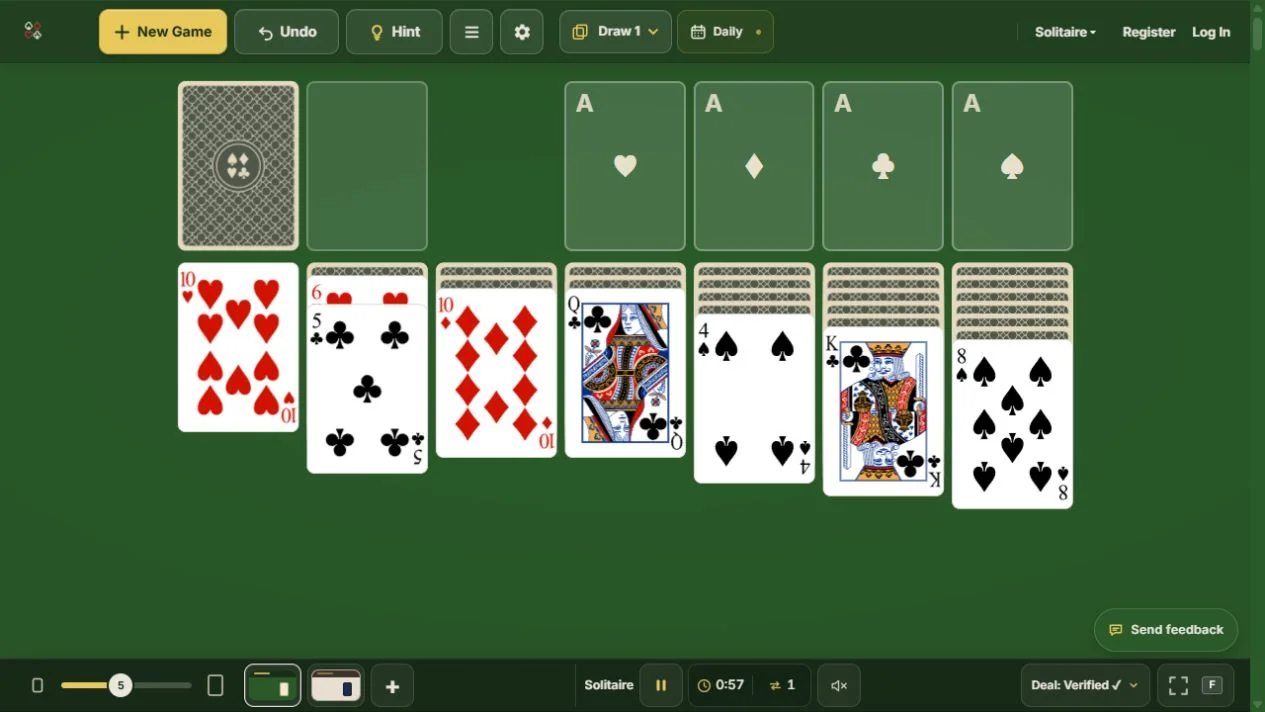
After the move. A queen of clubs is revealed, but it cannot sit on the visible king of clubs because their colors match. Original gameplay screenshot captured on PlaySolitaire.io.
Compare consequences when two moves compete
Other deals will offer a harder choice. Imagine two exposed black fives and only one available red six. Both moves are legal, but placing either five uses the same destination. Look underneath each candidate before deciding. Does one uncover a hidden card? Does the other empty a column? What could use that empty column next?
Uncovering a hidden card is a sensible starting preference, not a promise of the best move in every deal. Clearing a column can be more valuable when a king and its sequence need somewhere to go. If neither move changes access to other cards, moving purely to make a tidy sequence may achieve very little. Compare the resulting positions rather than counting how many cards you moved.
Keep foundation progress in perspective
The four foundations finish the game by collecting each suit from ace to king. Tableau cards also serve as places to build, however. A black five might be ready for its foundation while a red four still needs it as a landing place. Consider that use before sending it upstairs.
This version lets a top foundation card return to the tableau when the move follows the normal descending, alternating color rule. That can restore a useful destination, but it is still worth watching the dependencies. If you change solitaire apps, check the rules of that implementation instead of assuming every control and permitted return move is identical.
Draw only after checking the changed board
Once you have reviewed the visible moves, the stock becomes your next source of possibilities. In Draw 1, each turn exposes one card on the waste pile. Only its top card is available. A card you cannot use now might become useful after you move a tableau sequence or free a foundation.
Draw 3 changes this calculation. Cards arrive in groups, and removing the top waste card can make another accessible. It also changes the grouping on a later pass. The opening example uses Draw 1 deliberately: it keeps the stock rule simple while you practise reading the tableau. It does not claim that every deal can be won.
Replay a decision rather than chasing a faster score
Undo is useful for comparing the two positions around a doubtful move. Predict what an alternative will uncover, try it, and check your prediction. The Game menu also offers Restart for the same deal; New Game gives you different cards. Replaying is a practice exercise, with knowledge you did not have the first time.
Start with the small question illustrated here: what will this move reveal, and what can the exposed card actually do? Answering it will not solve every Klondike deal. It will make the next decision more deliberate than drawing another stock card simply because the button is there.

Leave a Comment