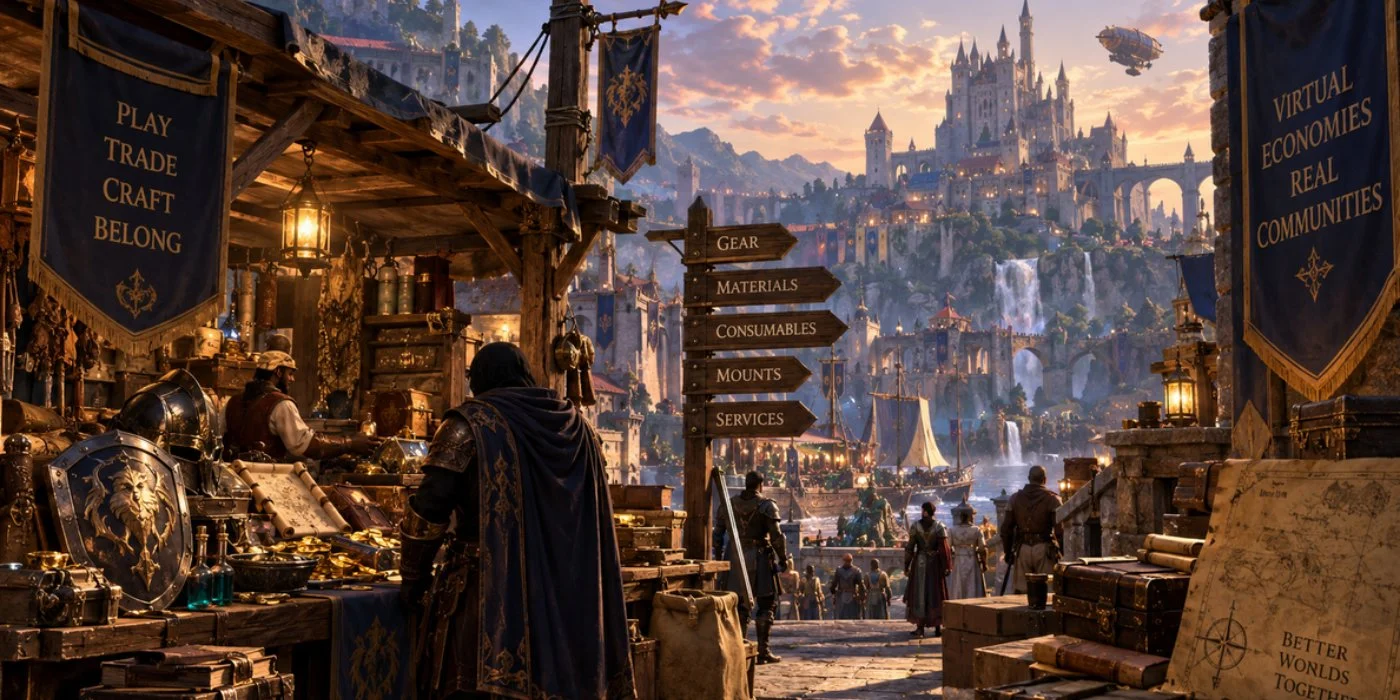
A busy virtual city can look surprisingly similar to a real one. Players trade resources, compete for valuable items, pay for services and spend hours trying to accumulate currencies that technically exist only inside a game. Yet the decisions made in these digital economies can shape how people play just as strongly as combat systems, quests or level design.
From the auction houses of MMORPGs to player-driven marketplaces and premium currencies, modern games have become increasingly sophisticated economic spaces. Developers have learned that a convincing economy does more than give players something to spend. It creates goals, encourages interaction and gives virtual worlds a sense of permanence.
Understanding how those systems work also helps explain why economies have become such an important part of modern game design.
More Than Gold And Coins
The first thing to grasp is that a modern online game economy is rarely just about collecting coins. In persistent multiplayer worlds, currency connects crafting, equipment, trading and progression, turning what initially looks like a simple reward system into an important part of the wider player experience.
That distinction matters because a basic currency system simply gives players something to spend, while a functioning virtual economy creates choices. Players can save for expensive equipment, trade resources with others or spend hours learning which items are becoming more valuable as the game changes.
The picture becomes more complicated as digital entertainment increasingly connects virtual activity with real-world spending. When someone moves from earning fictional currency in a game to using something like a richard casino login, the nature of that economy changes significantly: one system primarily deals with virtual resources earned or purchased for entertainment, while the other can involve actual money and financial risk.
The Multiplier Effect
The same basic principle that makes real economies interesting can also be seen inside large multiplayer games: one player’s actions rarely exist in isolation. A resource gathered by one player may be sold to another, transformed into equipment by a crafter and eventually resold through a marketplace.
This circulation is what separates a simple in-game shop from a genuine player-driven economy. A miner supplies materials to a blacksmith, the blacksmith produces equipment for another player, and the currency earned from that transaction can then be spent elsewhere.
As thousands of players repeat these exchanges, prices begin responding to supply and demand. A newly released update can suddenly make one crafting material extremely desirable, while an item that was valuable a month earlier may lose much of its worth.
Rewards, Currency And Progression
The most visible way an economy influences a game is through progression. Currency gives players a measurable reward for their time, while valuable items provide goals that can take days or even weeks to achieve.
The most common economic elements tend to fall into a few areas:
Currency — gold, credits and other resources give players a flexible reward that can be saved or spent.
Equipment — weapons and armour create demand for crafting materials and valuable drops.
Crafting — professions allow resources to move between players instead of simply disappearing into NPC shops.
Trading — marketplaces and auction houses let supply and demand influence the value of items.
World of Warcraft shows how interconnected these systems can become. Gold earned through quests or selling items can be spent on equipment, consumables, mounts and services, while professions create another layer of exchange between players. An item that seems worthless to one character may be exactly what another player needs for crafting or progression.
Those systems are rarely perfectly balanced, though, and that is an important caveat. Veteran players can accumulate enormous reserves of currency while newcomers start with almost nothing, and changes introduced through updates can dramatically alter the value of particular resources. A healthy virtual economy therefore requires constant adjustment rather than a single set of rules that works forever.
The Non-Combat Pivot
The smartest online games have learned that keeping players engaged does not always mean giving them another enemy to fight. Trading, crafting, collecting and managing resources can become substantial activities of their own, giving players reasons to remain in a virtual world even when they are not completing traditional objectives.
The World of Warcraft Model
World of Warcraft is a particularly clear example because its economy has developed alongside the game for more than two decades. The Auction House gives players a central marketplace where materials, equipment, consumables and collectibles can change hands, with prices responding to everything from server populations to major updates.
For some players, understanding those fluctuations becomes a game within the game. They buy materials when prices are low, anticipate demand around new content and search for opportunities to resell items at a profit. None of that requires defeating a raid boss, yet it can still provide progression, competition and long-term goals.
Other online games have taken the same idea in different directions. Some place crafting at the centre of their economies, while others rely heavily on player marketplaces or limited resources. The mechanics differ, but the principle remains the same: a virtual world feels more convincing when players have meaningful things to do beyond its primary gameplay loop.
When One Resource Takes Over
For all the benefits of a detailed virtual economy, relying too heavily on a single currency or resource can create serious balancing problems. When almost every meaningful activity depends on the same commodity, changes to its supply can affect the entire game.
A few common situations make the risk clear:
Economic system | What can happen | The lesson it offers |
|---|---|---|
Excess currency | Prices steadily increase | Games need effective currency sinks |
Extremely rare resources | A small group can control supply | Scarcity needs careful balancing |
One dominant marketplace | Prices affect nearly every activity | Trading becomes central to progression |
Inflation is perhaps the clearest example. Players continuously generate new currency through quests, enemies and other activities. If enough of that money is not removed from circulation through repairs, fees, cosmetics or other expenses, the average amount of wealth held by players can steadily rise.
The reverse problem can be just as frustrating. If important resources become too scarce or expensive, newer and more casual players may struggle to participate in parts of the economy at all. Balancing a virtual marketplace therefore means managing both abundance and scarcity rather than simply making valuable items difficult to obtain.
The Push To Diversify
Recognising those risks, developers of long-running online games increasingly build several overlapping economic systems rather than allowing a single currency to control everything. Gold may remain the basic unit of exchange, but crafting materials, reputation rewards, seasonal currencies and collectible items can create separate progression paths alongside it.
This approach gives developers more control over how different parts of the game evolve. A new expansion can introduce resources connected specifically to its content without completely destabilising an established marketplace, while limited currencies can encourage players to participate in particular activities without simply buying everything with wealth accumulated years earlier.
The underlying lesson applies well beyond any individual MMORPG. Virtual economies work best when players have several meaningful ways to earn, trade and spend resources. A diverse system gives developers more tools to manage inflation and progression while giving players more freedom to decide what they actually want to pursue.
The Economy Behind The Game
Virtual economies reshape online games through a chain reaction, turning simple rewards into systems of trading, crafting, collecting and progression. At their best, they give ordinary items meaning and allow players to set goals that exist independently of quests, combat or competitive rankings.
The challenge is keeping those systems balanced as both the game and its community evolve. Too much currency can create inflation, excessive scarcity can make progression frustrating, and poorly designed real-money mechanics can blur the line between gameplay and spending. The most successful virtual worlds therefore treat their economies as living systems that need to change alongside the players using them.
What begins as a few pieces of virtual gold can eventually become one of the forces holding an entire online world together.
FAQ
How do virtual economies benefit online games?
They create additional forms of progression and give players reasons to trade, craft, collect resources and interact with each other. A well-designed economy can keep activities meaningful even after players have completed much of a game’s traditional content.
What is the multiplier effect in a virtual economy?
It describes how one player’s economic activity can create opportunities for others. A gathered resource can be sold to a crafter, transformed into an item and traded again, allowing currency and resources to circulate between many players.
Why can virtual game economies become unbalanced?
Inflation, excessive scarcity and differences in player wealth can all disrupt an economy. Long-running games are particularly vulnerable because experienced players may accumulate resources much faster than those resources leave the system.
How do developers keep virtual economies balanced?
Developers use currency sinks, trading fees, crafting requirements, new resources and adjustments to item availability. Updates can also introduce separate currencies or progression systems to prevent accumulated wealth from dominating every new piece of content.

Leave a Comment