
Guide to Food and Drink Stalls in RollerCoaster Tycoon 1 and 2
Food and Drink stalls are a feature in all games.
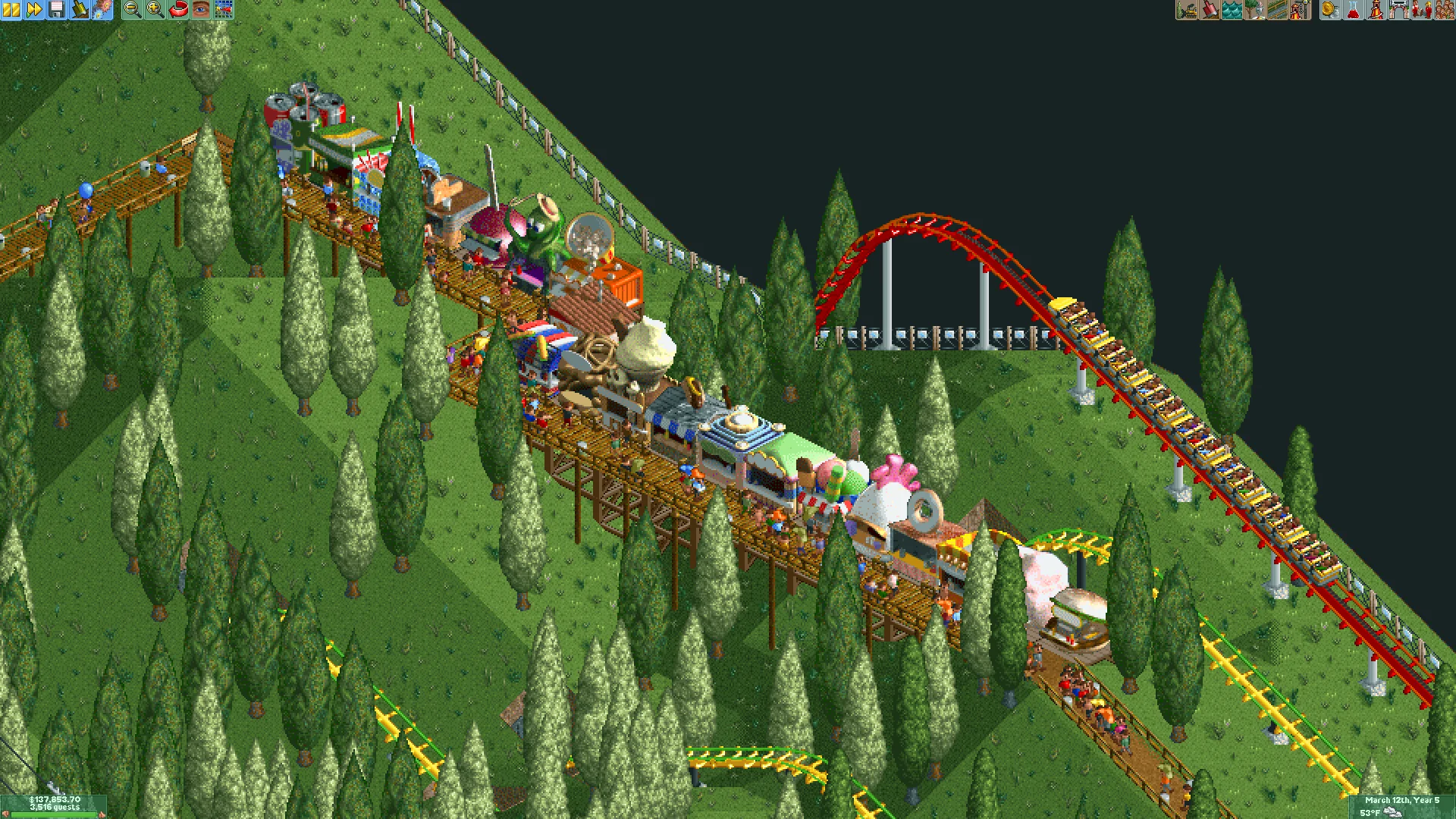
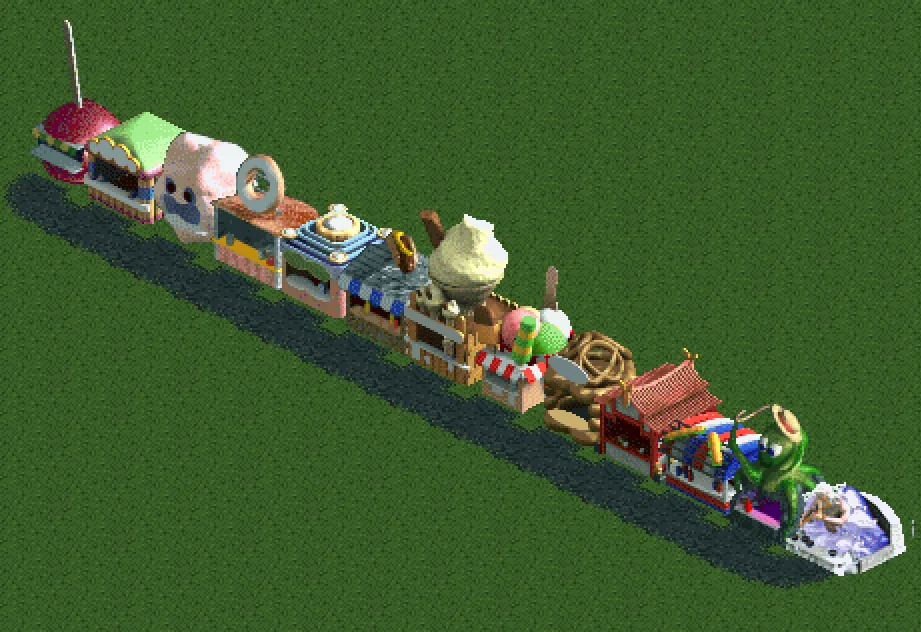
(A collection of food and drink stalls in a custom-built Rainbow Summit)
Types of Food and Drink Stalls
There are 27 food stalls in the game.
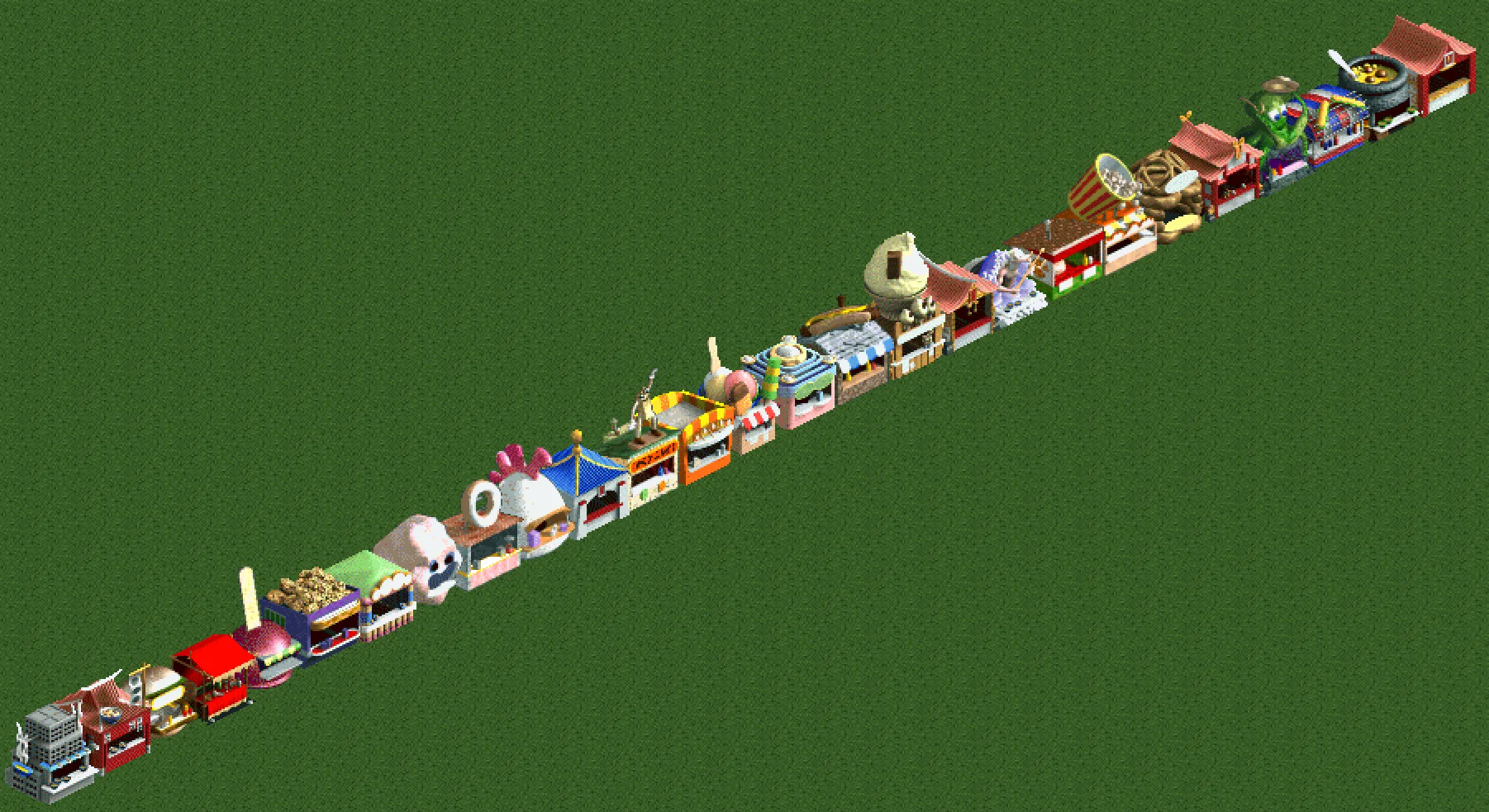
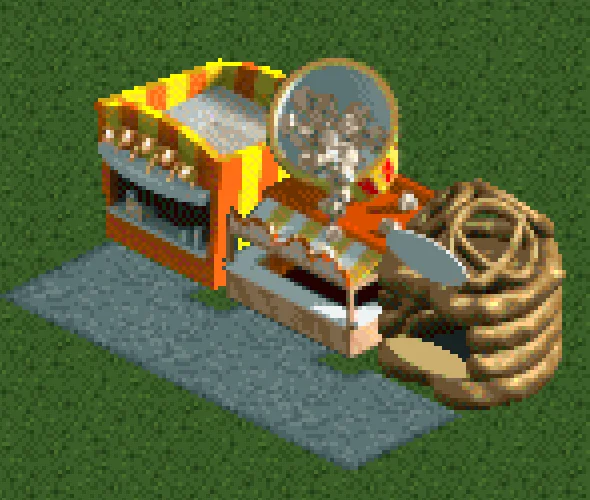
And there are 11 drink stalls in the game.
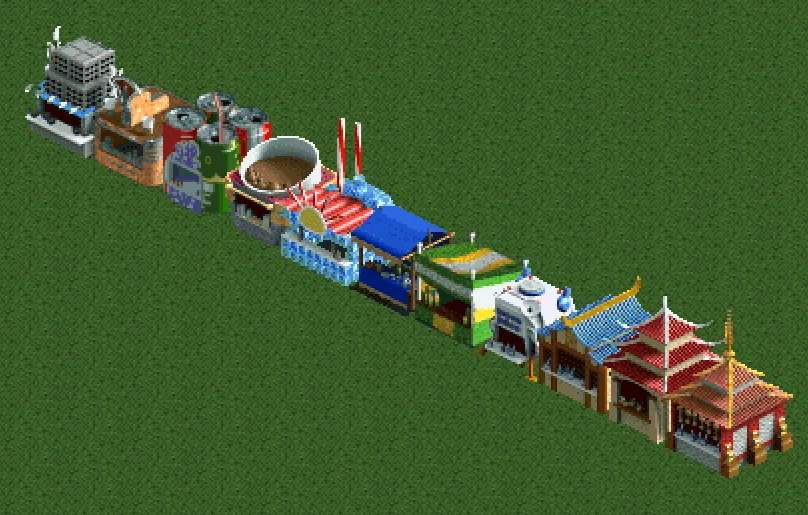
In the RCT1 base game and Corkscrew Follies, the Drink Stall (third one from the left) is the only stall that sells beverages. The Loopy Landscapes expansion for RCT1 and future games add other stalls that sell beverages too.
Drink stalls do not count as food stalls for the sake of fulfilling the requirements for Best Park Food or Worst Park Food awards. The Art Deco Food Stall sells Beef Noodles and Lemonade, meaning that it functions as both a food and a drink stall, but the game internally registers it as only a food stall. It is placed in both pictures for the sake of context.
Many stalls also sell the exact same item as other stalls. For example, the Fries Shop and Fries Stall both sell fries as their food item. If the option to synchronize the prices of the items throughout the park is enabled, the price of the item will be synchronized across all of the stalls that sell it, even if they are from different stalls.
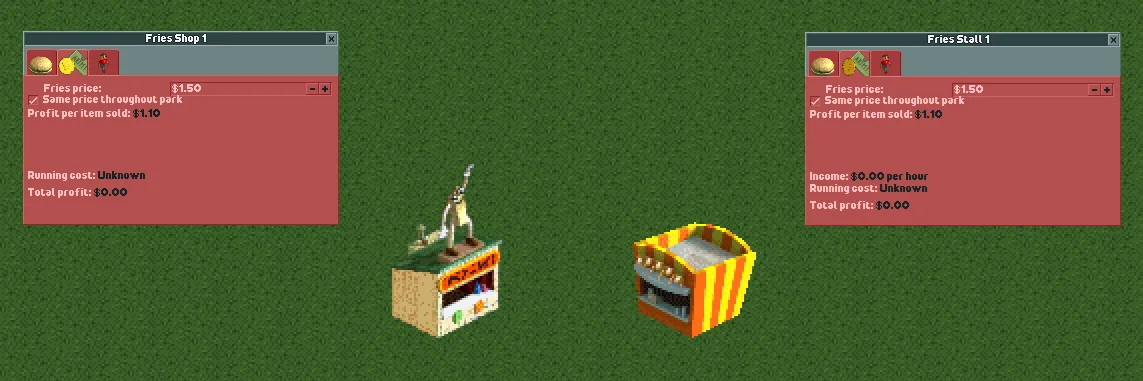 The requirements for Best and Worst Park Food count stalls, not items. Therefore, the Fries Shop and Fries Stall both count as two different food stalls for the sake of those awards.
Item Pricing and Availability
Unlike real life, stalls in the game do not have a limited stock. However, each item in the game still has a "price per item" simulating the cost of buying the item to stock the shops. At the end of each month, the game multiplies the cost of the item by the number of times the item was sold at the stall, and then subtracts that amount from your current amount of money.
This means that while the amount of money you make from each sale is the price of the item, the "profit per item sold" is how much you're actually making in relation to the upkeep costs. In general, the amount of money you spend per food item is negligible, but if you're tight on cash, this is something you may wish to keep in mind.
Many items fluctuate in price depending on the current temperature, with some items like Burgers or Hot Chocolate being able to be sold at higher prices if the temperature is cold, and some items like Ice Cream or Lemonade being able to sold at higher prices if the temperature is hot. This feature is intended to simulate some foods being cold or hot, but food temperature has no effect on the guests.
Additionally, guests will never buy Ice Cream if the temperature is cold or it's raining, no matter how cheap they are. Cotton candy cannot be purchased in the rain either, but can still be bought if the temperature is cold.
Below are tables for the minimum price every stall item in the game can be sold at per temperature range. There are other factors that can increase the price that guests are willing to pay, but it will never go below the prices in these charts.
.webp)
.webp)
Guests can still pay more money than this if they're sufficiently happy.
Guest happiness is measured on a scale of 0 to 255. There are three thresholds in which guests may still be willing to buy the item if it's slightly overpriced.
At less than half of the maximum happiness, guests will generally be willing to spend upwards of 10 or 20 cents over the base price, but this falls off quite quickly. There is also still a 12.5% chance that the guest will refuse to buy the item if it's any amount over the maximum base price.
Between 128 and 180 happiness (about 50%-70%), guests will always be willing to buy an item 10 cents over the maximum base price. Each other pricing threshold is also doubled, allowing them to spend up to $1.50 over the base price of the item, although the chances of this is very slim.
Over 180 happiness, this threshold doubles again. They will always be willing to spend up to 30 cents over the maximum, and are very likely to spend a whole dollar over. They can potentially even spend up $3.10 over the maximum and still buy the item.
Guests will never be willing to spend $3.20 or higher over the base prices no matter how happy they are.
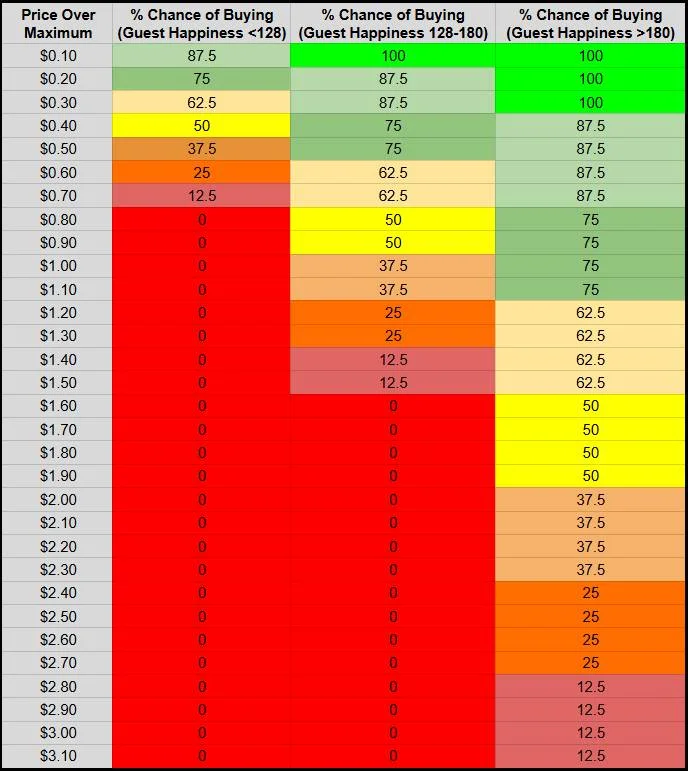
The optimal price to set the price of your food and drink stalls is probably about 20 cents higher than the base price. Your happiest guests will always be willing to buy them at this price (assuming they can afford it), whereas guests that aren't as happy are still incredibly likely to buy it, and even if they don't, they might run into another stall later down the line and buy a different item.
If you don't want to turn away guests, leaving the prices at their maximum base price is perfectly acceptable. Even at this price, they will still pay for themselves in very little time and produce lots of stall profit over time.
When Do Guests Decide to Buy A Food/Drink Item?
If a guest is sufficiently hungry or thirsty, it will search for the closest food or drink stall in the park and head towards it. What counts as the "closest" stall is determined strictly by the raw number of tiles from the guest's current location to the stall in Manhattan Distance, and not how long they need to walk to get there. This means that it's possible for the "closest" stall to be a stall that requires guests to walk by other stalls first.
Once the guest walks over to the stall, they will buy the item if they can afford it and are willing to buy it. If they can't buy it for some reason, they will walk away from the stall. It's also possible for a guest to end up bumping into a stall without looking for one, although they're unlikely to buy a food or drink item since they aren't hungry or thirsty enough yet to trigger the stall pathfinding yet.
Once a guest buys a food or a drink item, they will begin consuming the item, which is a process that varies in time depending on the item in question (view next section). While a guest is consuming a food or drink item, they will walk slower and will also sit on a bench if they happen to walk onto a path tile with a bench with at least one empty bench slot on it. Guests cannot hold onto more than one food or drink item at a time, but they can otherwise perform every normal action that guests without one can do.
When a guest buys a food or drink item, they will always finish the food or drink item that they buy. Even if their Hunger or Thirst reaches 0 in the middle of consuming the item, they will continue consuming the item and any increase on stats (Thirst and Bathroom for food, or just Bathroom for drinks) will still occur as normal.
Because of the nature of the way guests pathfind to stalls, and the fact that they can't hold onto multiple food or drink items at once, there's no practical benefit to building "food court" areas since the vast majority of the sales will come from a select few stalls in the area. Despite this, I often do this anyway for the aesthetics.
Litter
When the food item is fully consumed, it might leave a piece of litter in their inventory. The difference between them is entirely cosmetic, but not every food item leaves litter. In fact the amount of food items that don't produce litter is higher than you might expect.
Candy Apples, Cookies, Cotton Candy, Donuts, Funnel Cakes, Ice Cream, Pretzels, Roast Sausages, Sub Sandwiches, and Tentacles all produce no litter when the guest finished them.
Theoretically, you could combat your park's litter accumulation by only building food items that produce no litter. However, since every drink item produces litter, you will still need to build bins anyway.
While a guest is holding a food or drink item, in addition to being able to physically see the item, it will appear in their inventory. When they finish the item, it will be replaced by one of several different "trash" items (if the item is not one of the above items without a trash item).
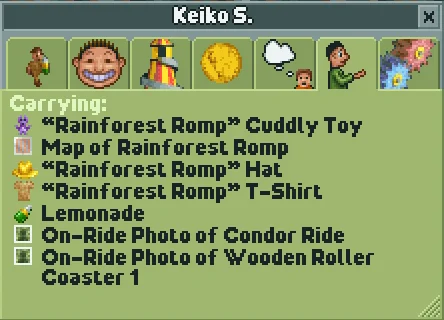
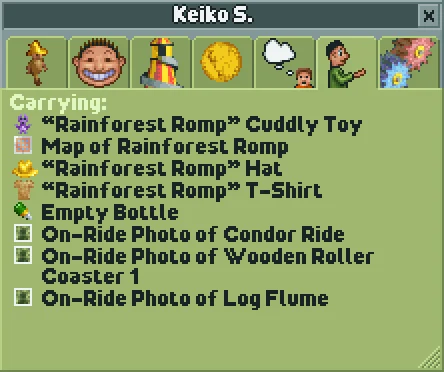
While a guest is holding a trash item in their inventory, they will throw it away in a litter bin if they happen to walk past one that isn't full. They however will not actively seek out a bin to throw it in. They will need to walk past it on their own. Guests will not try to throw away trash in full bins. They will simply walk past it instead.
While a guest is holding a trash item, there is a random chance for them to throw it on the ground every few seconds, meaning that some guests are simply inconsiderate enough and will litter an item as soon as it's empty.
Due to a quirk with the way the behavior is coded, if a guest decided to use a bin to throw a trash item away, but that bin becomes full within the split second they are walking towards the bin, that guest will throw the item on the ground instead.
Despite what you might expect, Security Guards do not prevent guests from littering.
Effects of Food and Drink
What you may not be aware of is that not all food and drink items behave the same way. Every food and drink item has the exact same effect on a guest's stats, but they differ in how long they take to eat, resulting in each food having a different total effect on each stat in question.
Every food and drink item in the game has its own "consumption time", which is a value of how long it takes a guest to fully consume a food or drink item. The relationship between the consumption time and the effect it has on a guest's Hunger, Thirst, and Bathroom stats all scale linearly. As a result of this, Burgers decrease Hunger and increase Thirst and Toilet by exactly twice as much as Popcorn since its consumption time is exactly twice as high.
Food items in fact, have a huge variation in their consumption times.
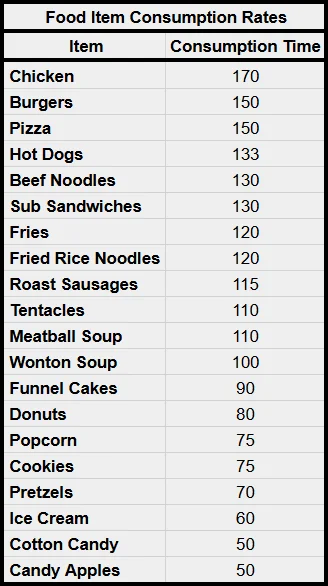
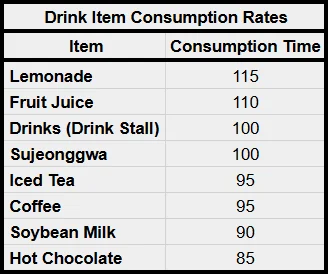
Drink stalls have much less variance in their consumption times. Otherwise, all other properties regarding consumption times for food items applies to drink items as well (with the obvious exceptions of drinks decreasing Thirst instead of increasing it, and having no effect on Hunger).
A very common belief around the internet is that certain foods like Popcorn or Pretzels are salty and increase Thirst faster. This is a myth.
There is no such mechanic relating to any type of food flavoring, and all guests are willing to eat every type of food in the game.
All food items decrease Hunger and increase Thirst and Bathroom at the exact same rate as each other. As a result of this, Burgers decrease Hunger and increase Thirst and Toilet by exactly twice as much as Popcorn since its consumption time is exactly twice as high. Counter to the myth, this means that "salty" foods actually increase Thirst less than most other foods instead of more because they have a small consumption time.
About_Author
Demonxz95 is the main "fan creation guy" on Out of Games, specializing in showcasing fan-made content from the Hearthstone community, with the occasionally unrelated article on the side. His love for card games started with Yu-Gi-Oh when he was a child and has since seen a resurgence with Hearthstone and MTG.
He can be reached through a PM on the site or on our Discord server.
Latest_RollerCoaster Tycoon 2_Guides

Guide to Awards in RollerCoaster Tycoon 1 & 2
Guide to Building a Bobsled Coaster in RollerCoaster Tycoon 1 & 2
// join_the_conversation
Sign in to share your thoughts, vote on comments, and connect with the community.
Comments
// no_comments_found
Be the first to share your thoughts!
Leave a Comment