

Guide to Building an Elevator in RollerCoaster Tycoon 1 & 2
Guide to Building an Elevator in RollerCoaster Tycoon 1 and 2.
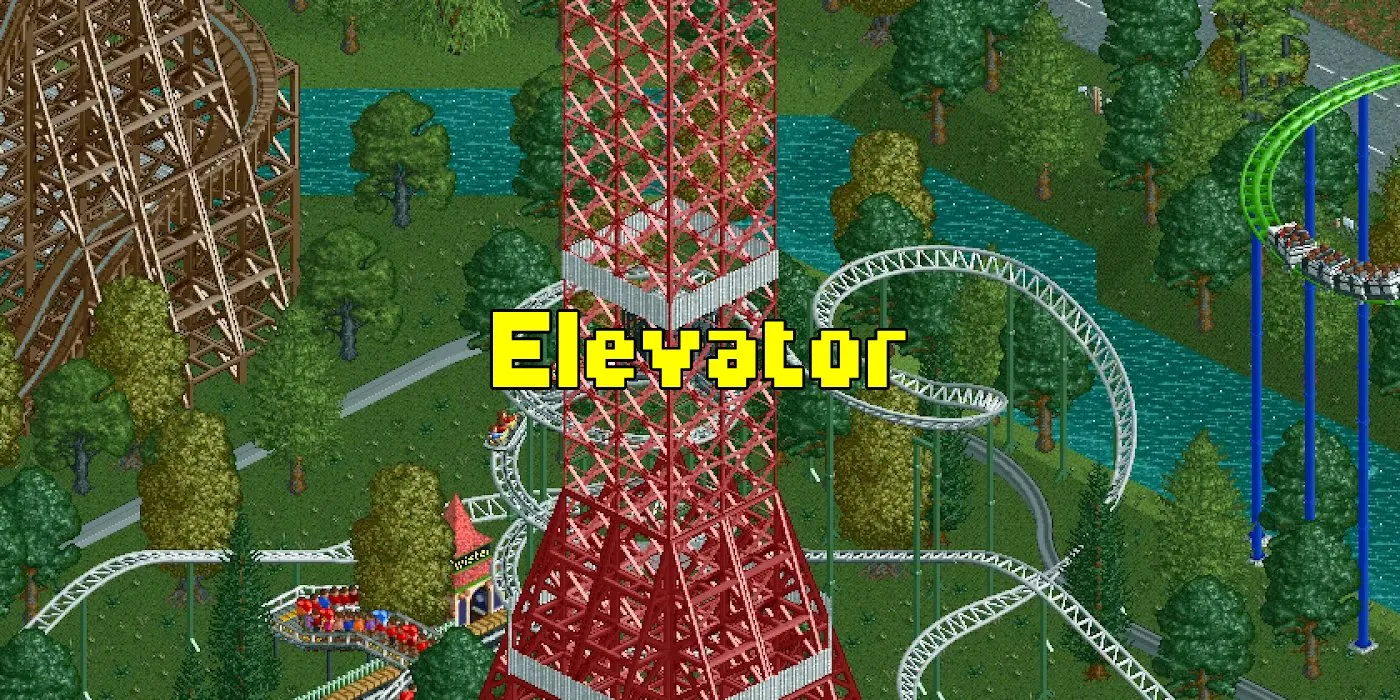
The Elevator is a Transport Ride in RollerCoaster Tycoon 2 and all future installments.
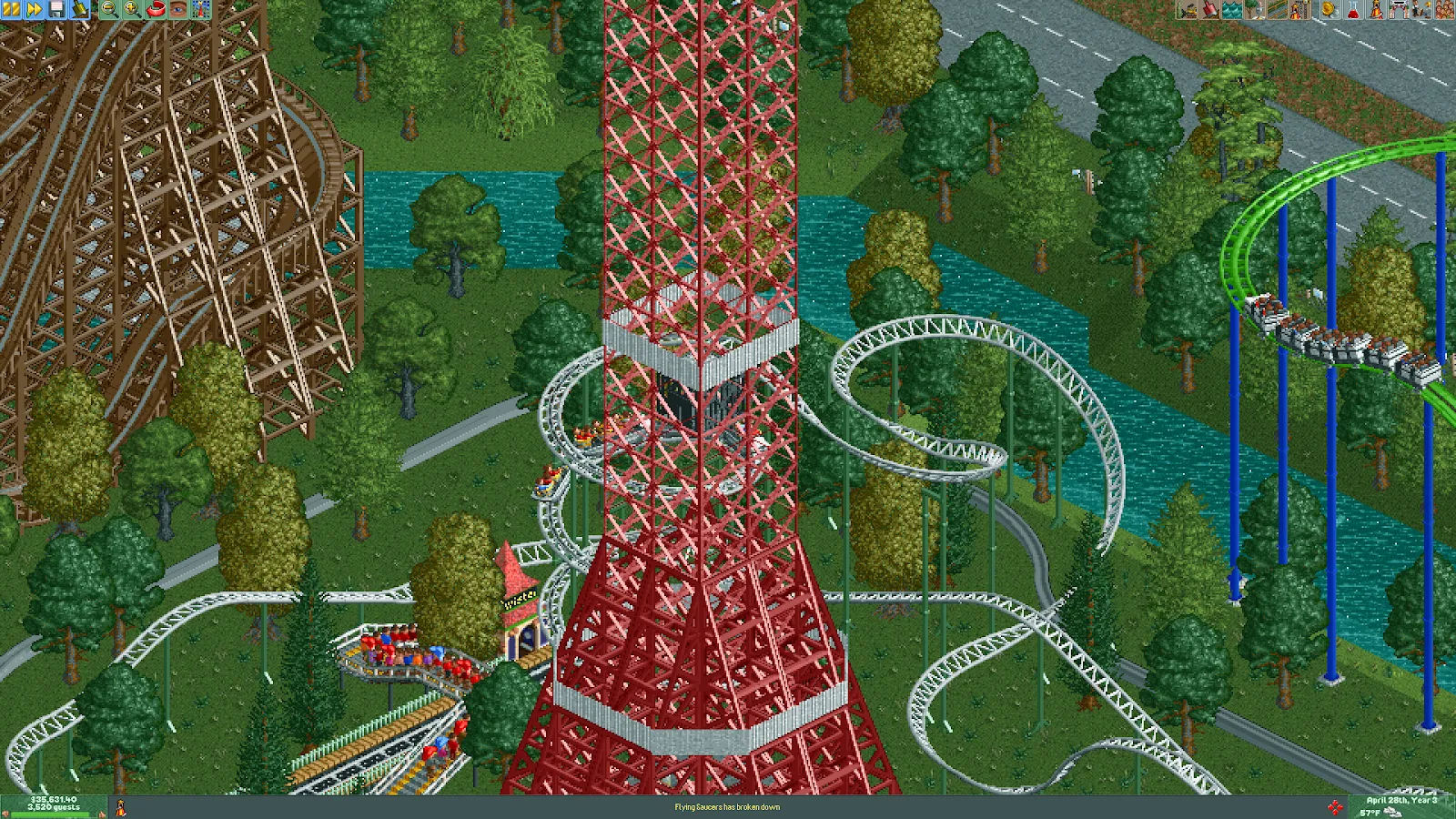
(Oil Derrick in Six Flags Over Texas)
“Guests ride in an elevator up or down a vertical tower to get from one level to another.” - In-game description
Transport Ride General Information
(This section is present on all Transport Ride guides. It is put inside a spoiler to avoid repetition.)
Transport Rides are rides that exist to move guests around the park quickly and without tiring them out. They are generally quite cheap to build per track piece, although because Transport Rides are designed to be quite long to allow guests to access faraway areas of the park, their total cost to build can sneak up on you. If you wish to, Transport Rides can also be built as one station, functioning as a Gentle Ride of sorts, although sacrificing the ability to disperse guests around the park is also cutting out potential profit since it will only be accessible from one area of the park.
Despite their function, guests do not view Transport Rides any differently than other ride types, meaning that guests who tend to gravitate towards more intense rides will generally refuse to ride them. Guest pathfinding also does not take Transport Rides into account and they will not use them to get to a specific place in the park quicker or without expending as much energy. Guests will ride Transport Rides, but they will not do so with the intent of getting to a specific area of the park, and whenever they get on one, they will always exit the ride on the very next station (if it has an exit building).
Transport Rides also have a unique ability in that they can make any guest ride them if they are free. If a Transport Ride is free, then a guest will always be willing to get on the ride even if they are extremely unhappy and desperate to go home. This function presumably exists to emulate the aforementioned pathfinding element of using them to get to the park entrance quicker, although it can also have the opposite effect and keep them in your park for longer, which tends to take a cut of your park rating. This downside can be eliminated if the only station on the Transport Ride with an exit building is one very close to your park entrance. This can be used as a means of helping lost guests find the park exit, although this will also disperse every other guest who gets on the ride to the exit as well, meaning that they won’t be in your other park areas. The other downside of this is that you’re obviously not making any money with a free ride, so this should only be considered if you’re making enough money to comfortably offset the ride’s operating cost and make an extra profit on top of that. If you're playing in a park with unlimited money (like Arid Heights or Lucky Lake), all Transport Rides will count as "free" and this functionality will be enabled.
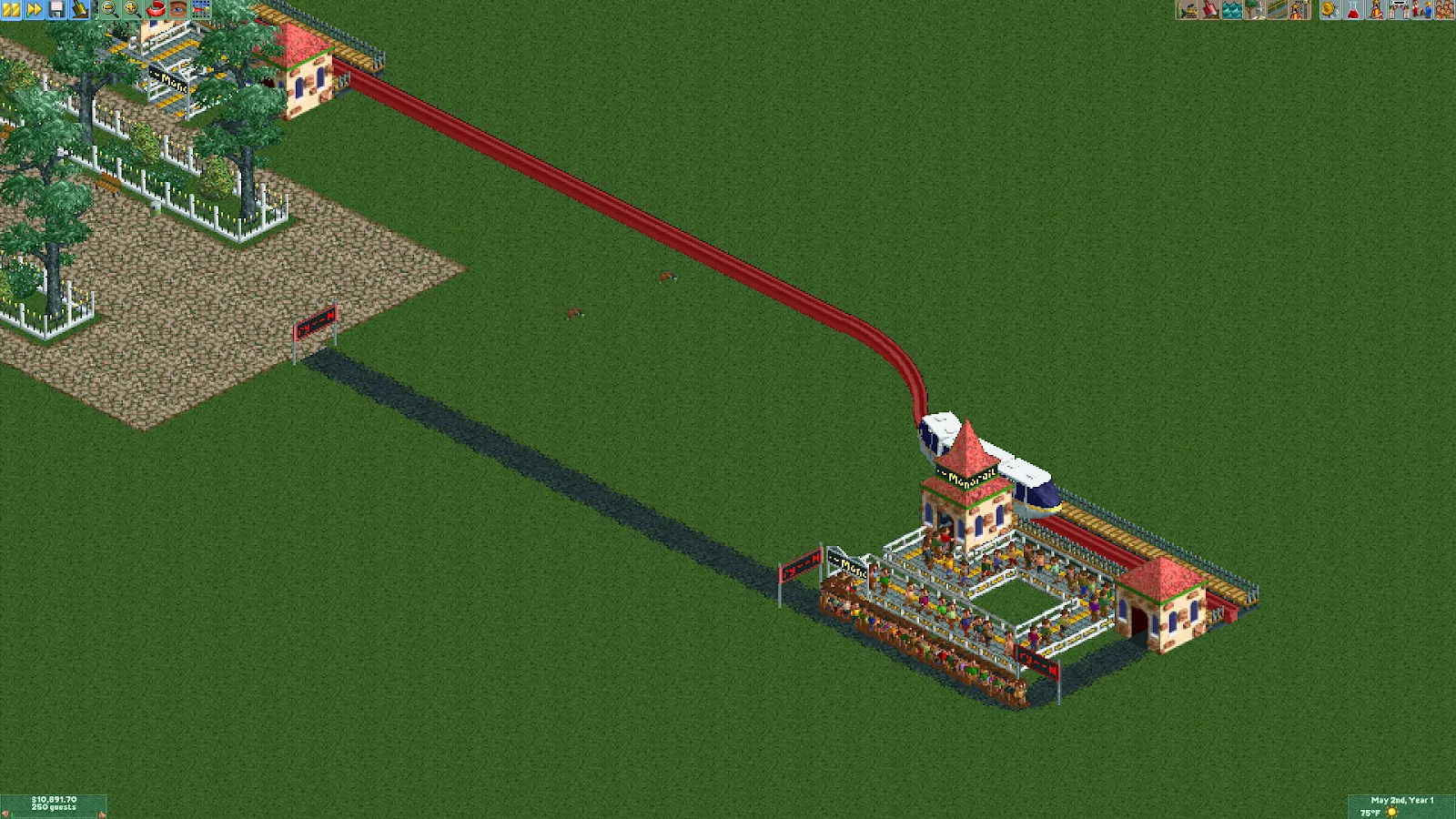
One implication of this feature is that if a part of your park is isolated from the rest and only accessible via a free Transport Ride, then the guests will eventually find their way back to the main area of the park by taking the Transport Ride back again. This is still a terrible idea as this leaves guests prone to becoming unhappy because they will attempt to navigate to a ride that’s in the main area of the park and won’t be able to detect that they need to take the Transport Ride back.
In spite of their noticeable downsides, Transport Rides can be quite good and building one in a large park is sometimes very useful as they have many advantages. Even though the guests won’t intentionally use it for this purpose, it will still help move guests around your park, and due to their very high ride capacity, can help fight overcrowding and make more money than you might expect since a larger number of guests can board them all at one time. Most Transport Ride vehicles are also sheltered meaning that they will provide a reliable source of ridership during a rainstorm.
In RollerCoaster Tycoon 1, all Transport Rides count as Gentle Rides for the purposes of Research. In future games, Transport Rides are their own Research option.
Transport Rides have low base Excitement Ratings, and are never intense or nauseating either. All of them having a base Intensity and Nausea of 0.50 or lower, and modifiers to those stats are not nearly as prominent as they are on other tracked rides. The Monorail and Miniature Railway in fact start with 0.00 for both of these stats and the only way that either of those two rides can increase this is through their max speed, average speed, and underground sections.
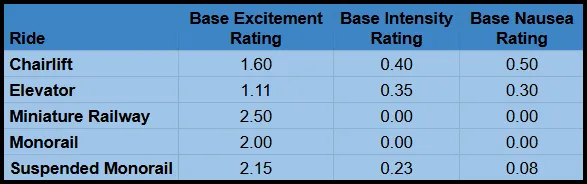
As long as your Transport Rides don’t fail any stat requirements, it is completely impossible for them to have stats lower than these. The Monorail for instance will never have an Excitement Rating of lower than 2.00 if you meet both stat requirements. Their low Intensity Rating means that they’re really good for guests who prefer less intense rides (doubly so for parks like Gentle Glen, which applies this intensity preference all around), although this also means that thrill-seeking guests will tend to complain that the ride isn’t intense enough and not ride them (again, guests do not view Transport Rides differently than normal rides). Their Nausea Rating is virtually nonexistent, so guests won’t become sick from being on the ride, although they might still throw up around the ride due to being sick from other rides in close proximity to the Transport Ride.
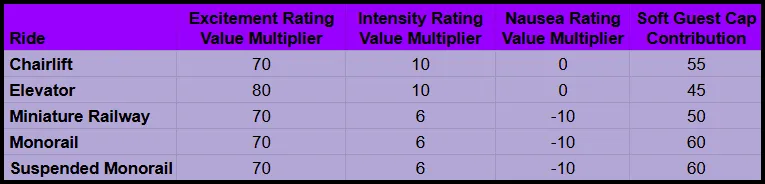
The amount of Park Value that Transport Rides contribute to your park is roughly average for non-coaster tracked rides. The Monorails and Miniature Railway all share a very interesting distinction of being the only rides in the game that feature a negative number in their Park Value contribution multipliers. In the case of all three, their Nausea Rating has a contribution multiplier of -10. This means that the Nausea Rating of these rides will actually detract from your Park Value, although since their Nausea Ratings are always very low, this has a very minimal effect overall, and the other two ratings will more than offset the Nausea penalty. All Transport Rides have a similarly average contribution to the soft guest cap, though in the case of the Miniature Railway and both Monorails, this amount will be low in relation to the amount of money you’ll most likely need to spend to build the ride.
Pre-Built Designs
Building Information
- Base Cost (With Scenery): $15,743.00 (Vanilla RCT2)/$17,555.00 (OpenRCT2)
- Base Cost (Without Scenery): $787.00 (Vanilla RCT2)/$799.50 (OpenRCT2)
Stats
- Excitement Rating: 5.63
- Intensity Rating: 0.35
- Nausea Rating: 1.02
Ride Length
- Distance: 292ft/305ft (89m/93m)
- Time: 22 seconds/17 seconds
Other Information
- Default Vehicle: Lift Cabin
Building Information
- Base Cost (With Scenery): $15,743.00 (Vanilla RCT2)/$17,555.00 (OpenRCT2)
- Base Cost (Without Scenery): $787.00 (Vanilla RCT2)/$799.50 (OpenRCT2)
Stats
- Excitement Rating: 5.63
- Intensity Rating: 0.35
- Nausea Rating: 1.02
Ride Length
- Distance: 292ft/305ft (89m/93m)
- Time: 22 seconds/17 seconds
Other Information
- Default Vehicle: Lift Cabin
Technical Information
Stats
- Base Excitement Rating: 1.11
- Base Intensity Rating: 0.35
- Base Nausea Rating: 0.30
Stat Contribution Values
- Excitement Rating Value Multiplier: 80
- Intensity Rating Value Multiplier: 10
- Nausea Rating Value Multiplier: 0
- Soft Guest Cap Contribution: 45
Building Information
- Cost of Station Piece on Fully Flat Ground: $156.00
- Cost of Straight Track Piece on Fully Flat Ground: $19.00 (Vanilla RCT2)/$19.50 (OpenRCT2)
- Cost of Supports (per unit per tile): $0.00
- Support Height Limit: None*
*The ride itself has no support height limit, but the game has a hard cap on how tall anything can be built above standard ground level, which everything in the game is bound by. This limit is 600ft/182m/+120.
Building an Elevator
The Lift (renamed Elevator in OpenRCT2, and will use that name throughout this guide) is a unique Transport Ride in that it can only move vertically, which makes it very situational in its usefulness. It uses the same construction principles as the other tower rides in the game, with its stations taking up a 3x3 space and the track taking up only one tile, meaning that it’s a very compact ride.
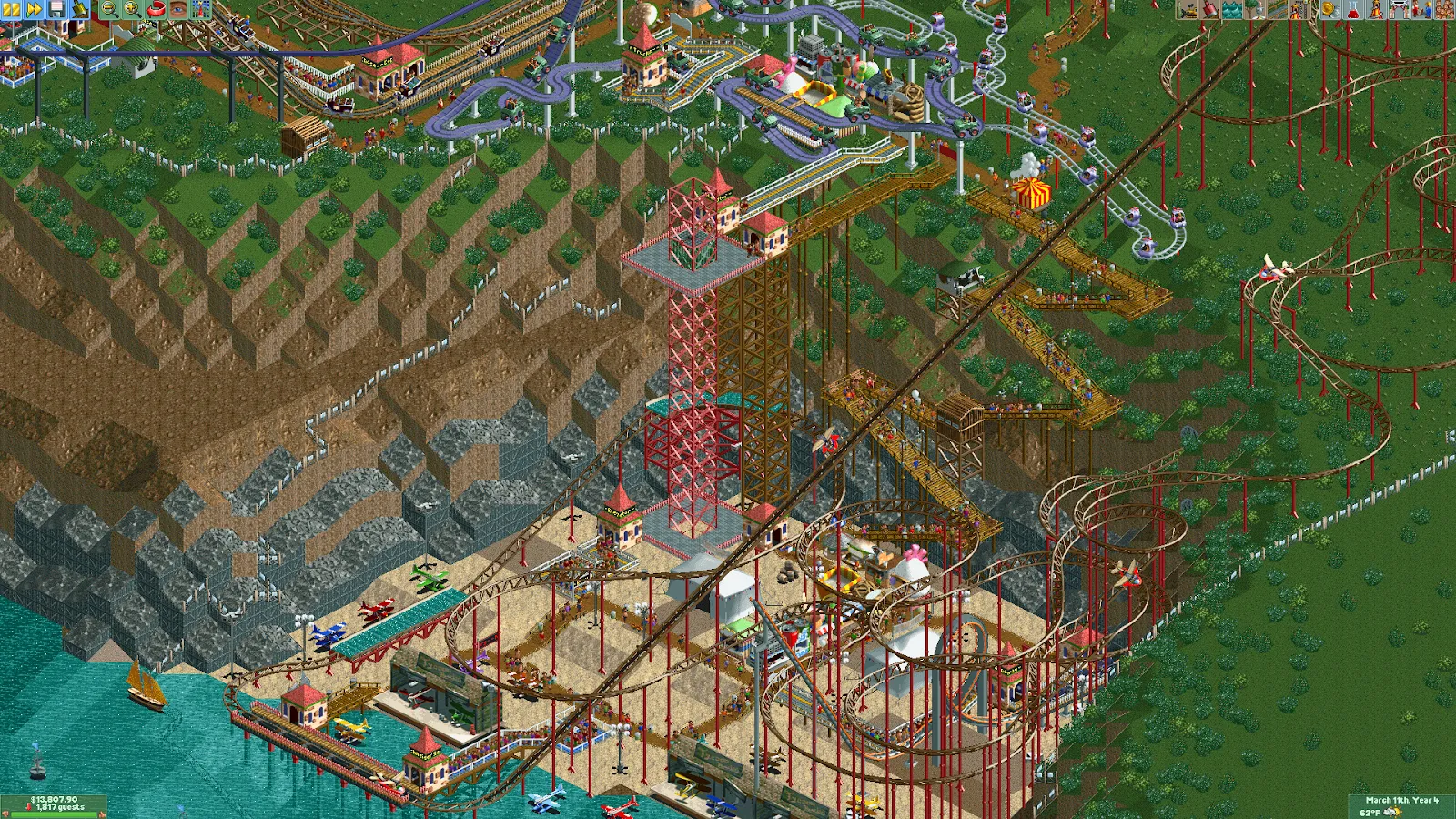
Unlike in real life, where guests would normally ride the Oil Derrick for the observation deck, guests in the game do not have any thoughts about their heights off the ground or the view they would receive from being at the top. This means that building Elevators to function as observation towers like the Oil Derrick is a terrible idea as the guests are likely to get stuck on the platform because they refuse to take the Elevator back down. Instead, the best way to use Elevators is for navigating steep cliff faces as seen in parks like Schneider Shores.
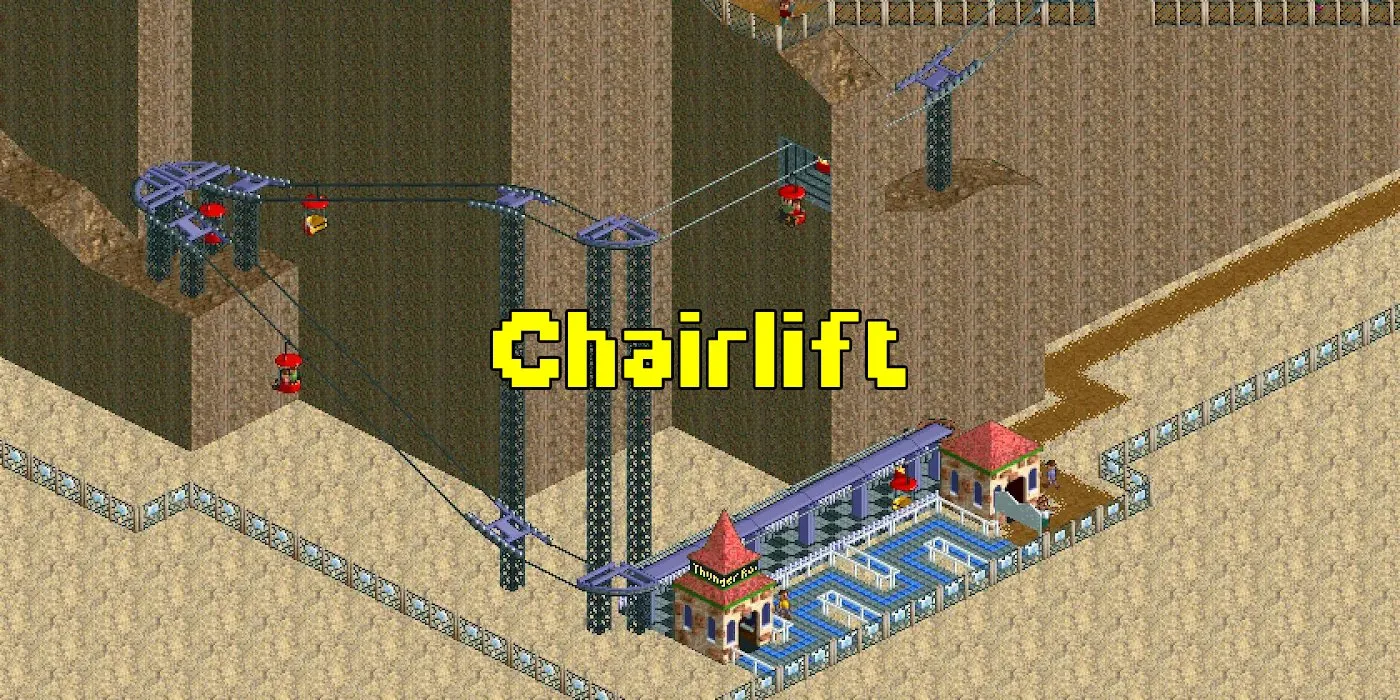
Another downside of the Elevator is that it can only hold one car, giving it a lower potential throughput than all of the other Transport Rides. In most cases, building a path up/down to where you want to go will be better, and if your goal is to transport guests upward, the Chairlift is generally better as it processes more guests and is more maneuverable. The Elevator does however have a slight advantage of being more compact.
The Elevator also has a unique property of being the only ride in the game that must have a minimum of 2 stations to function. Despite its mechanical nature, it also cannot break down. It’s not clear if this is a bug or an intended feature, but every version of OpenRCT2 keeps this behavior. This also makes it the simplest Transport Ride to maintain. Even though it can’t break down, Mechanics will still inspect the ride periodically based on its inspection interval setting. If you wish to hyper-optimize the inspection cycle of your Mechanics, you can set the Elevator’s inspection interval option to ‘Never’, though the difference this will make will be minimal at best.
Stats
Despite having the lowest base stats of any Transport Ride in the game, it can actually have much better stats overall than any of the others. This is because it has much higher bonuses than the other Transport Rides. It has the highest BonusScenery value of any ride in the game (tied with the Observation Tower) with a value of 83,662. It also has a BonusTowerRide of 45,875, which it gains from just being built tall.

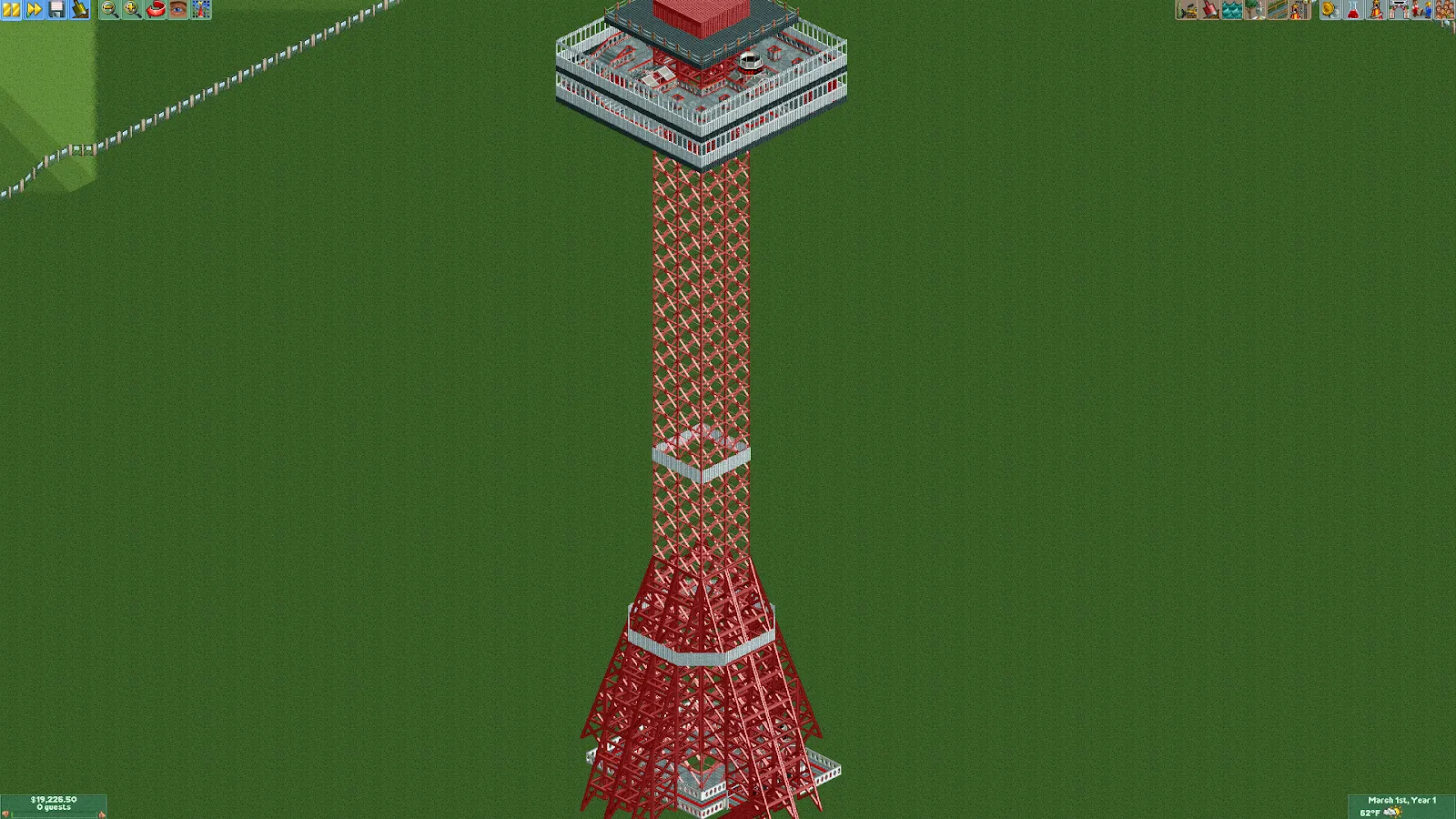
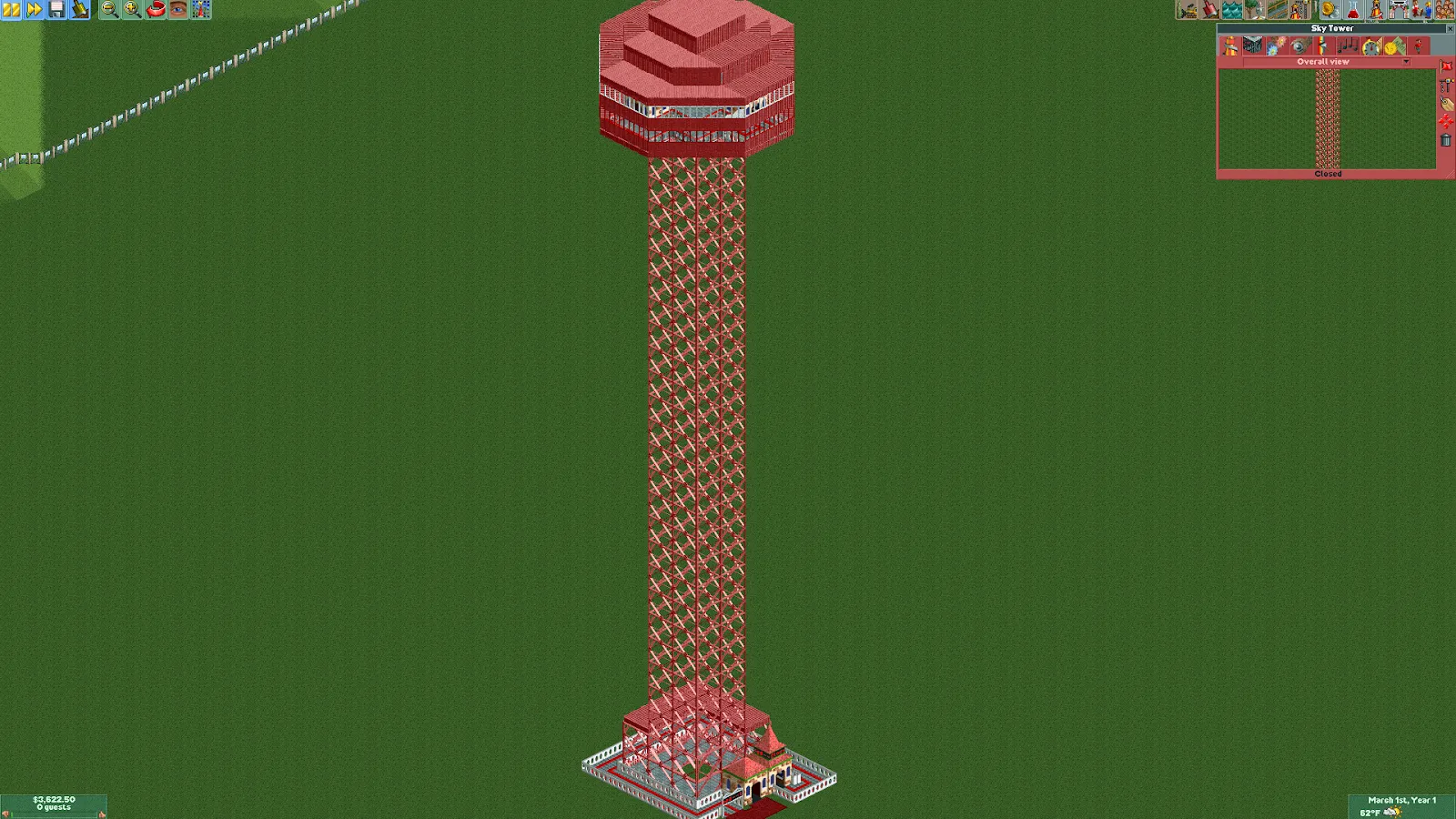
To demonstrate how large of an impact this has, let's look at the Oil Derrick again. We'll build one without its scenery, and then build one of it with it scenery.
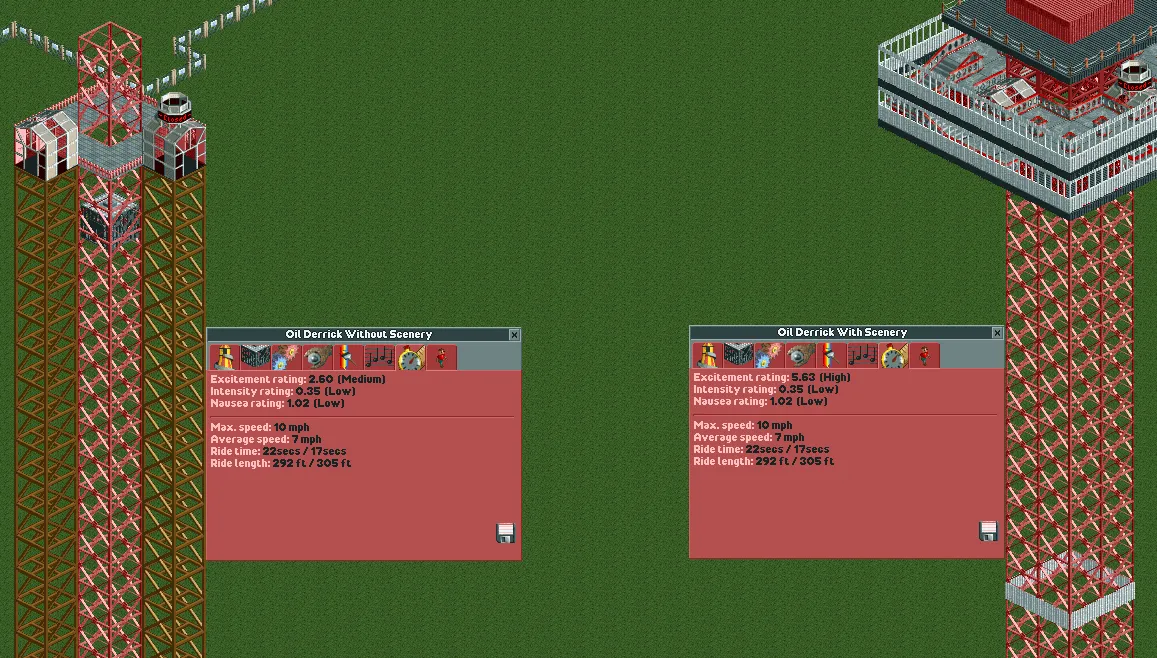
Note: The reason its upward and downward trips have different ride lengths is because the elevator slightly jump upward before making its downward trip, which contributes to its ride length.
With all of the scenery around the ride, its incredibly high BonusScenery value causes it to jump up in Excitement for over 3 whole points... just from the scenery alone. The scenery bonus for every ride caps at 50 pieces within a 5-tile radius of the ride, meaning that every individual scenery piece up to that cap is contributing 0.06 points of Excitement. This might not sound like much on face value, but as you can tell by this example, this very quickly stacks up when you spam lots of scenery pieces around the ride.
This combined with its high Excitement value multiplier means that the Elevator can actually have a much higher ticket price than all of the other Transport Rides, although because its throughout and maximum capacity is really low, it can't really make good use of it.
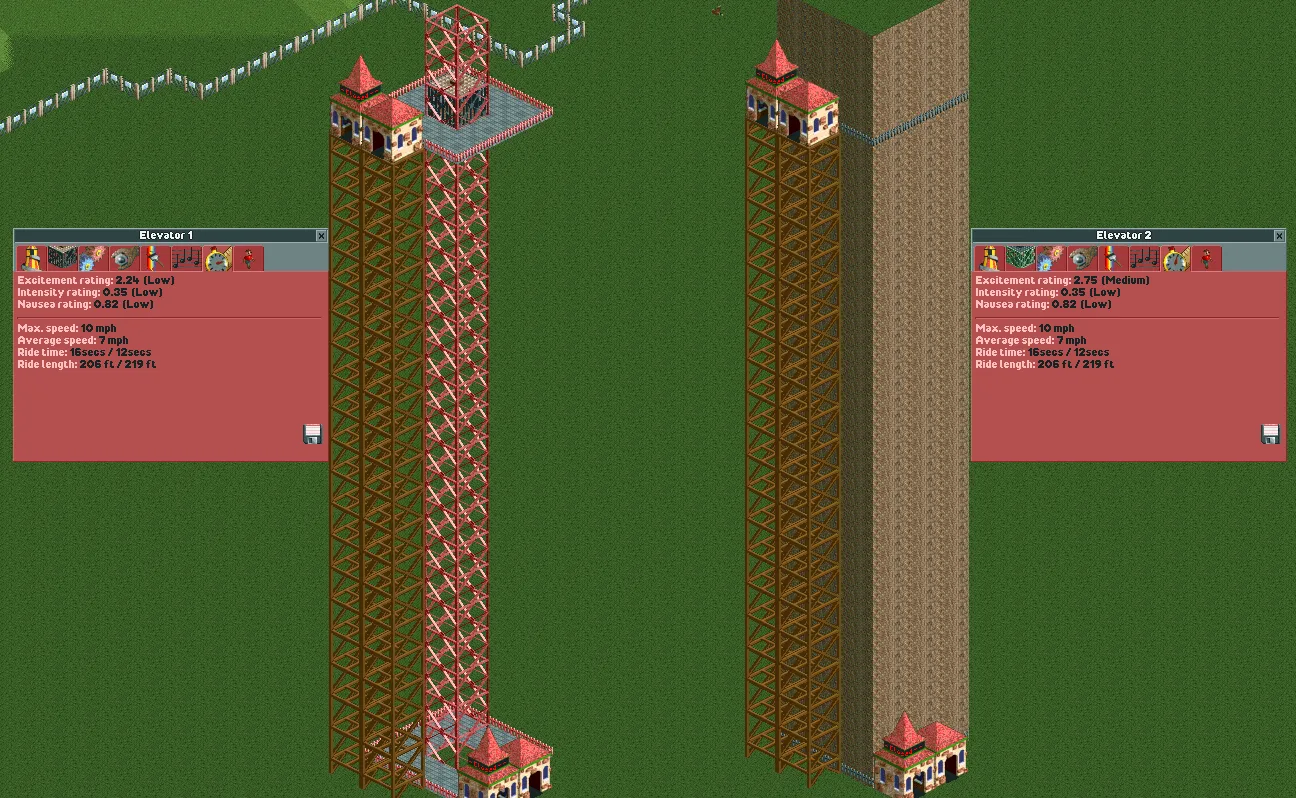
From its RequirementUnsheleterd value, it appears to be coded to get its Excitement Rating divided by 4 if too much of the track is underground. However, even if we build the entire track underground, it does not apply a penalty.
Vehicles
The Elevator only has one vehicle option, which comes in three different styles:
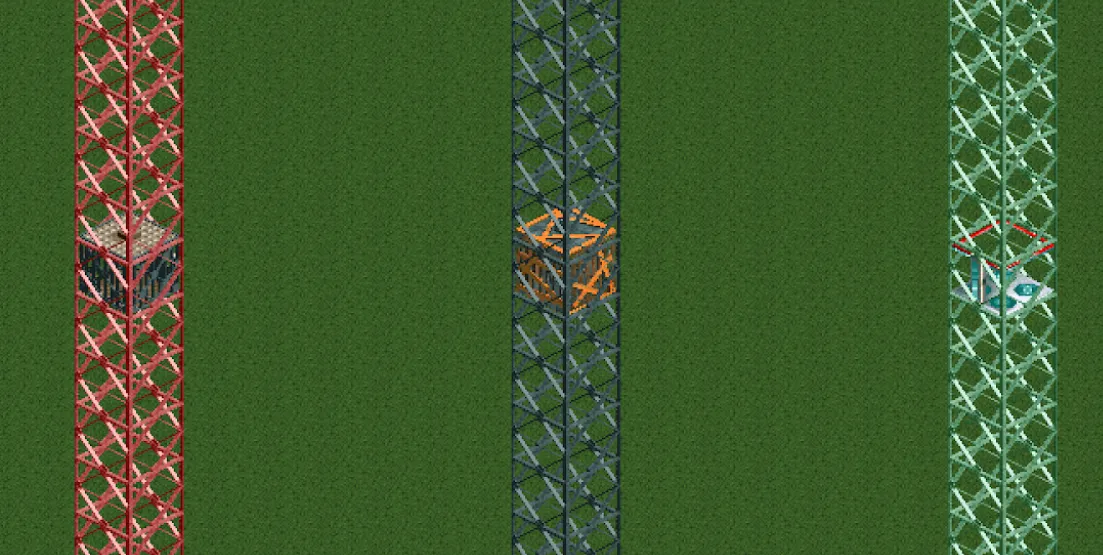
The standard Lift Cabin is included with the RCT2 base game as is the ride itself, whereas the Mine Lift Cabin was added with Wacky Worlds and the Teleporter Cabin was added with Time Twister. Other than their appearance, each vehicle functions exactly the same. They each hold a maximum of 16 guests, moves upwards at 6mph (9km/h) when empty and at 5mph (8km/h) when full, and moves downwards at 10mph (16km/h) when empty and 11mph (17km/h) when full.
The Elevator is very limited in its operation due to the fact that it can only have a single vehicle on the track at a time. This means that if you set the ride to wait for a full load, guests on the other end might be stuck waiting in the queue line if guests don't get on the side where the vehicle is quickly enough.
Verdict
The Elevator is not an useful as it could've been.
Despite its potential to have really good stats and a high ticket price, it has a much lower throughput than all of the other Transport Rides and only being able to be built vertically means that it's much more situational than them too since it can't function in parks that don't have a lot of elevation changes. Its compact design however does mean that it won't get in the way of your other rides very much.
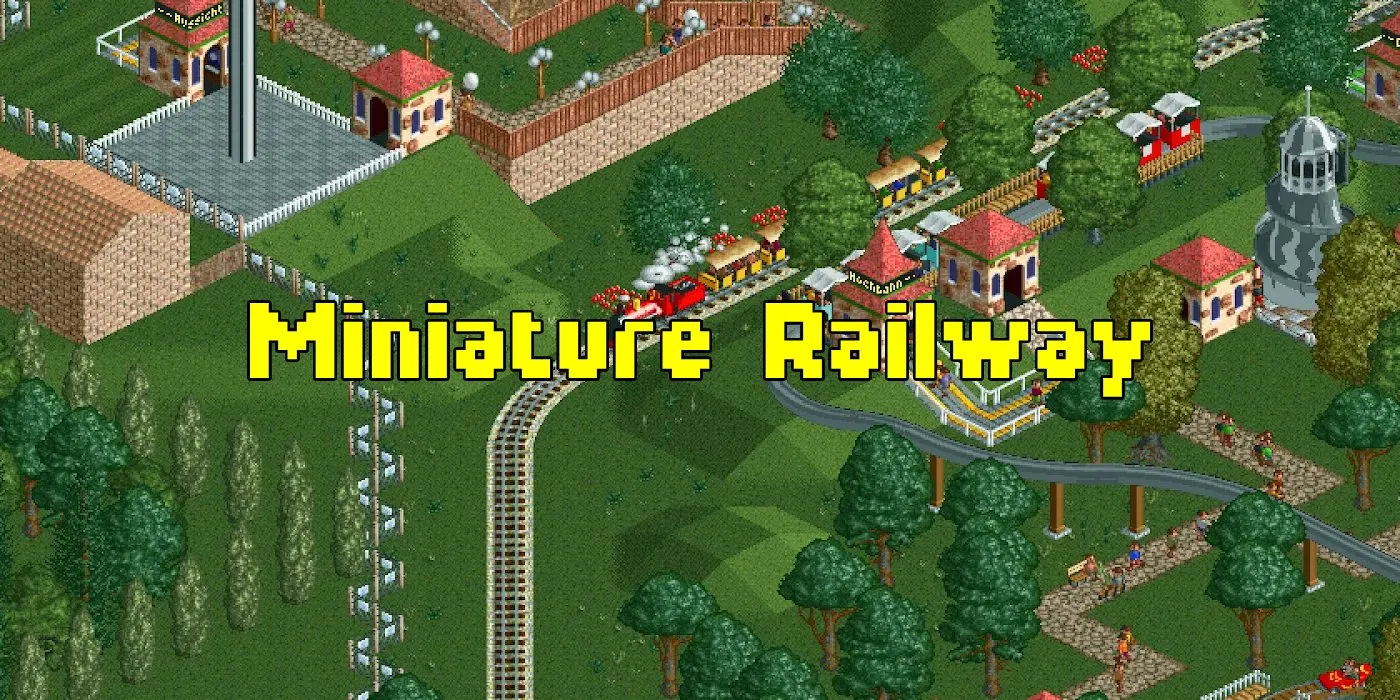
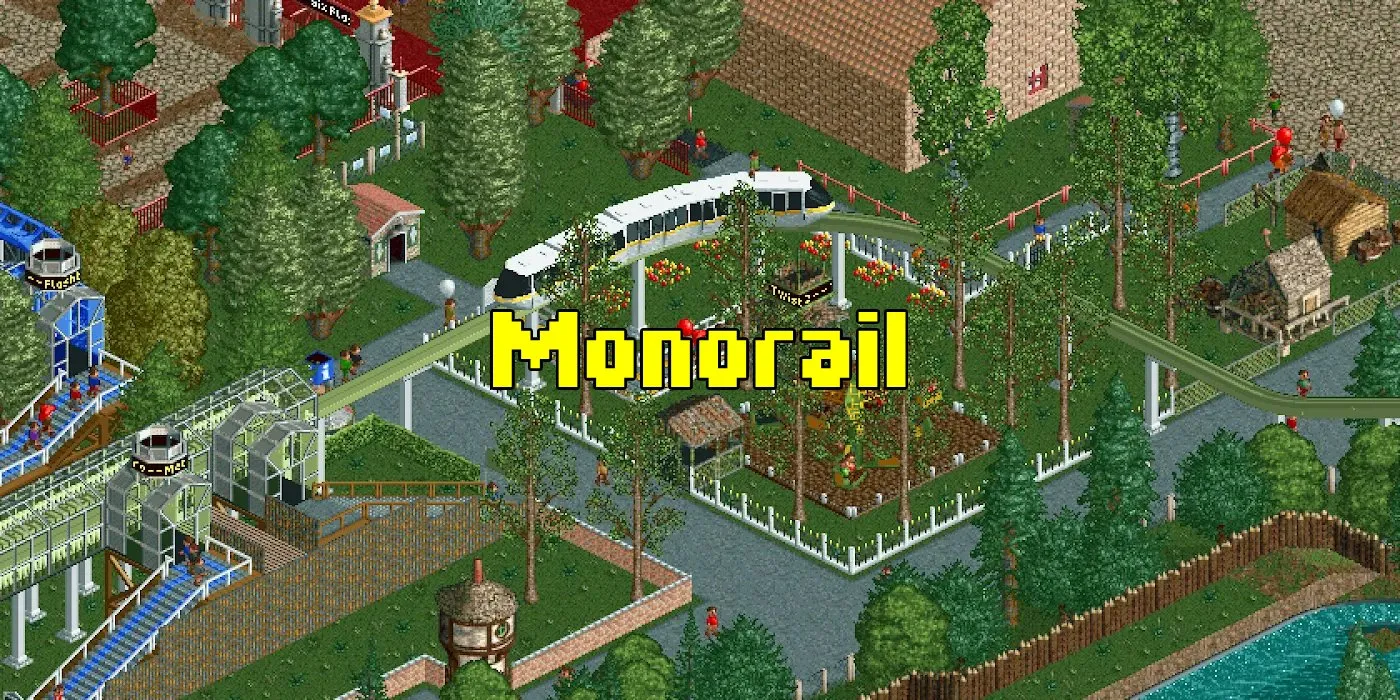
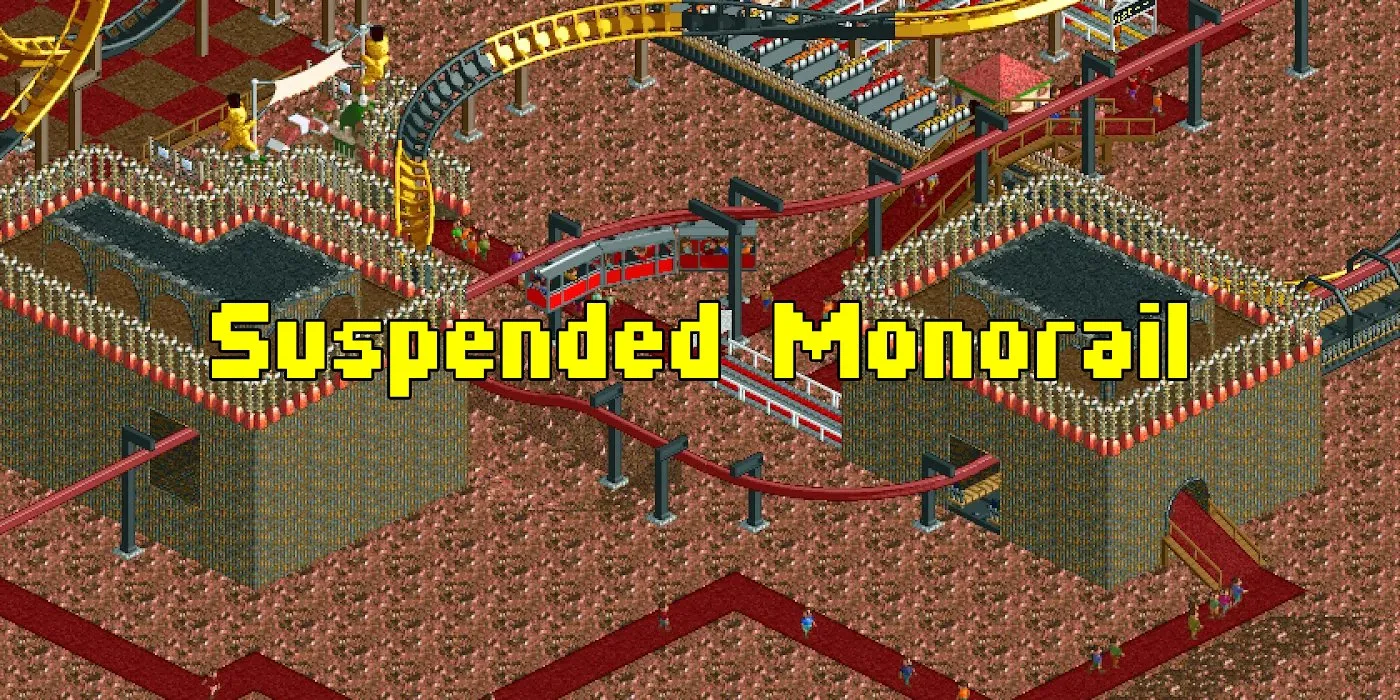
Other Transport Rides
About_Author

Demonxz95 is the main "fan creation guy" on Out of Games, specializing in showcasing fan-made content from the Hearthstone community, with the occasionally unrelated article on the side. His love for card games started with Yu-Gi-Oh when he was a child and has since seen a resurgence with Hearthstone and MTG.
He can be reached through a PM on the site or on our Discord server.
More_Transport Rides_Guides
Base Building Tips and Tricks in Palworld

A Guide to Harth Stonebrew's Iconic Hands
Latest_RollerCoaster Tycoon 2_Guides
Guide to Food and Drink Stalls in RollerCoaster Tycoon 1 and 2

Guide to Awards in RollerCoaster Tycoon 1 & 2
// join_the_conversation
Sign in to share your thoughts, vote on comments, and connect with the community.
Comments
// no_comments_found
Be the first to share your thoughts!
Leave a Comment