
Guide to Building a Merry-Go-Round in RollerCoaster Tycoon 1 & 2
Guide to Building a Merry-Go-Round in RollerCoaster Tycoon 1 and 2.
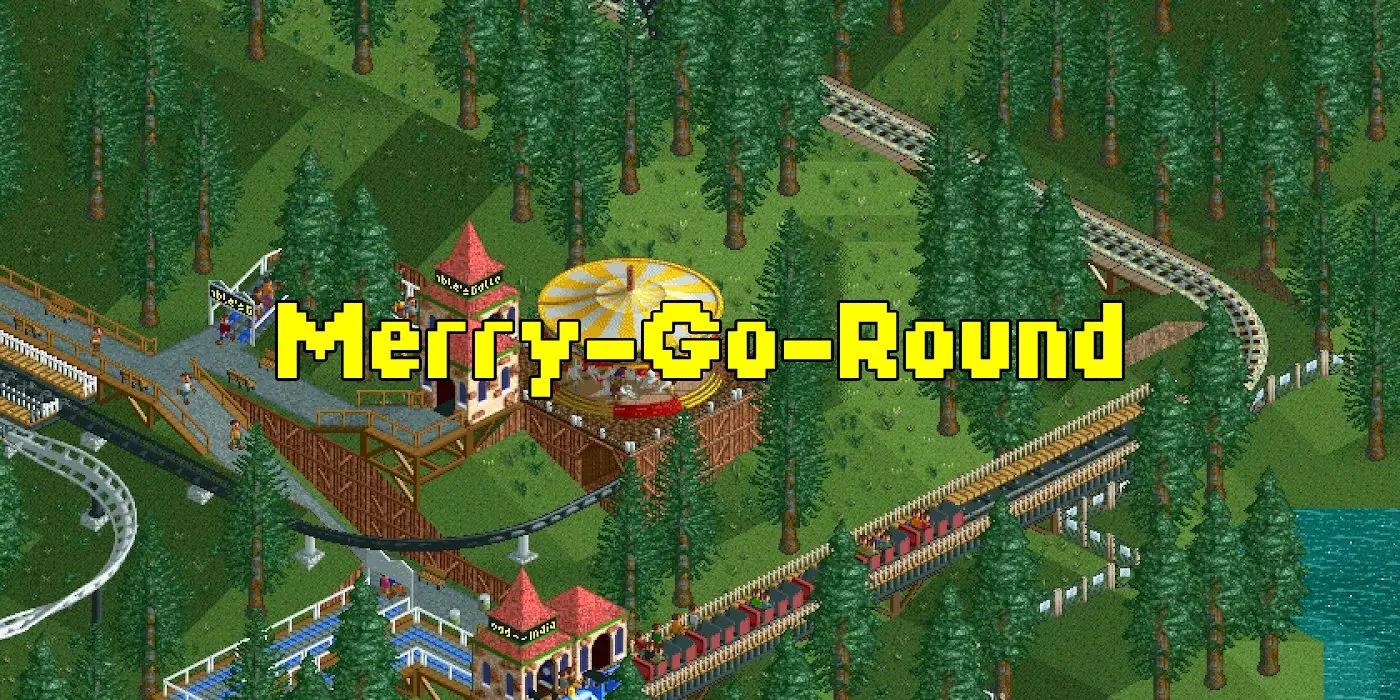
The Merry-Go-Round is a Gentle Ride in RCT1's base game and available in all future installments.
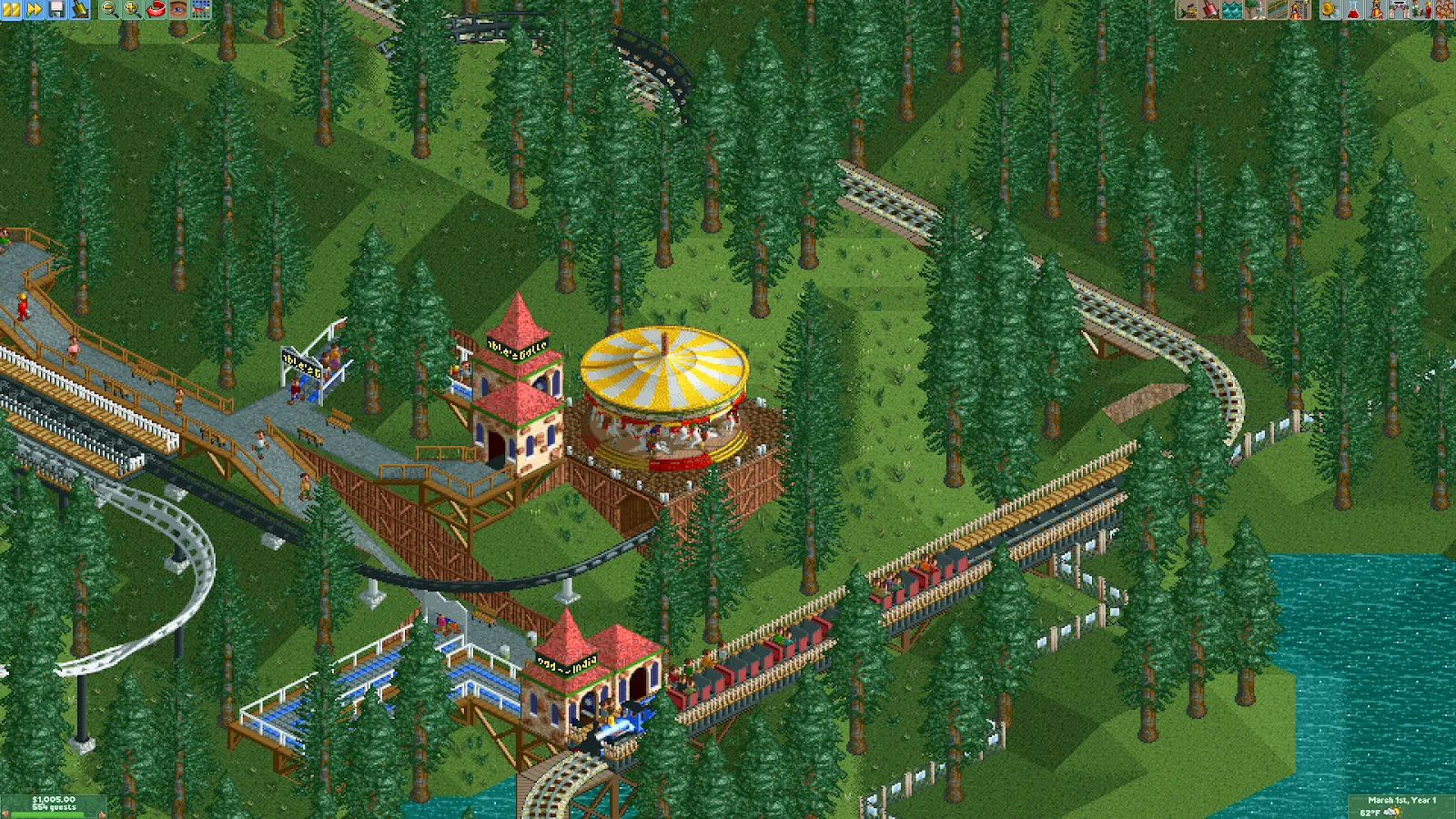
(Grimble's Gallopers in Diamond Heights)
“Traditional rotating carousel with carved wooden horses.” - In-game description
Technical Information
Stats
- Base Excitement Rating: 0.60
- Base Intensity Rating: 0.15
- Base Nausea Rating: 0.30
Stat Contribution Values
- Excitement Rating Value Multiplier: 50
- Intensity Rating Value Multiplier: 10
- Nausea Rating Value Multiplier: 0
- Soft Guest Cap Contribution: 45
Building Information
- Size: 3x3
- Base Cost: $460.00
- Cost of Supports (per unit per tile): $1.00
- Support Height Limit: 40ft/12m/+8
Other Information
- Guest Capacity: 16 (Base Variant)/32 (Double Deck Variant)
- Sheltered?: Yes
Building a Merry-Go-Round
The Merry-Go-Round is arguably the most iconic flat ride in the game (along with possibly the Spiral Slide). It is a simple 3x3 flat ride that is not very tall, so it doesn't take much effort too build over it. It is the third-most expensive Gentle flat ride in the game at $460.00, though this is obviously insignificant in the grand scheme of things.
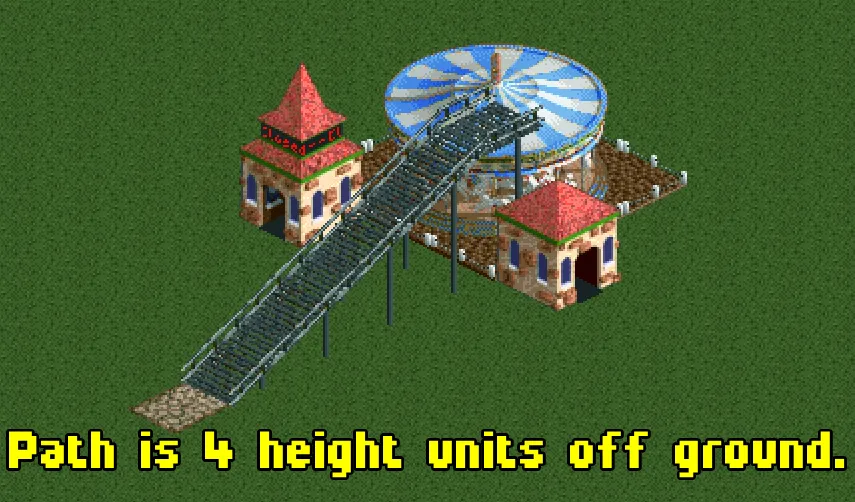
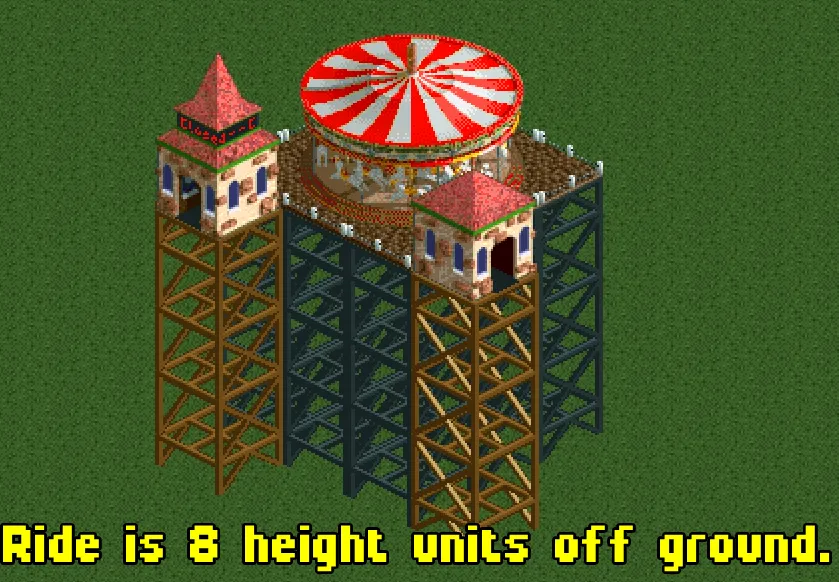
Additionally, it has one of the highest support limits of all the Gentle flat rides at 8 height units off the ground. Only the Crooked House and the Space Rings have a higher support limit. In the grand scheme of things, this is mostly useless, but if want to cram as many rides in as possible, the Merry-Go-Round's height limit may not go unnoticed after all.
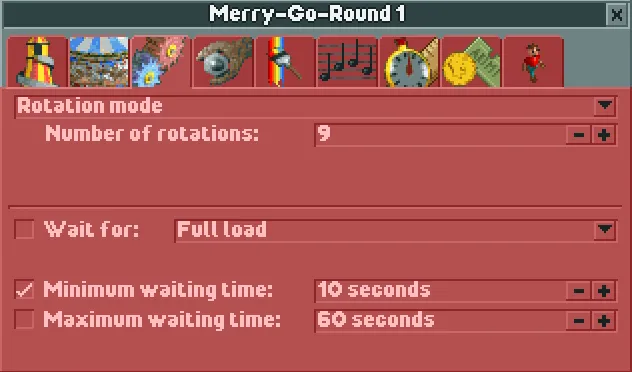
The Merry-Go-Round is not super customizable, but it does have one important function that you can alter: The number of rotations. This defaults at 9, but you can change this to any number between 4 and 25. This effects the ride's stats as well as obviously how long it takes for the ride to complete a full ride cycle.
The Time Twister expansion pack from RCT2 also introduces the Double-Deck Carousel. As the name suggests, it is two a merry-go-round that has two floors. This is translated in game as having double the capacity of the original Merry-Go-Round. Despite its larger size, neither its maximum support limit nor the required height for path clearance changes. This results in paths being able to clip through the top of the ride, but the game will still let you place them there.
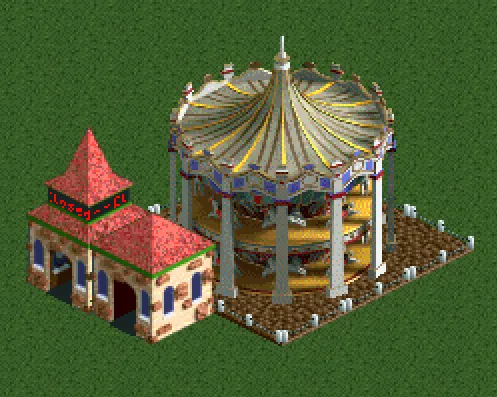
For all intents and purposes, the Double-Deck Carousel as exactly the same as the Merry-Go-Round except for its capacity and its stats. It costs the same amount of money and has all of the same building parameters as the standard variant. The difference is that the Double-Deck Carousel comes with not only double the capacity of the standard variant, but also a bonus of 11%, 3% and 1% to its Excitement, Intensity, and Nausea Ratings respectively.
This means that the Double-Deck Carousel is strictly better than the standard variant. If both rides are available, there's no reason to build the standard variant instead of the Double-Deck one.
One very interesting advantage of the Merry-Go-Round (specifically the standard variant) is how readily available it is in most parks. In every scenario from RCT1's base game, the ride is available to build as soon as you start the scenario. The expansion packs however do add some scenarios where it will need to be researched first, and even some where you can never build or research it at all.
Music
One of the most iconic things about the Merry-Go-Round is its music. The Merry-Go-Round, along with the Bumper Cars and the Flying Saucers, are the only rides in the game that come pre-loaded with music by default. The music on the Merry-Go-Round is referred to in-game as "Fairground organ style", which consists of 10 (in RCT1) or 11 (RCT2, RCT Classic, and OpenRCT2) pieces of music strung together to create one loop of music that goes on for over 40 minutes. Contrary to popular belief, music does not affect the stats of the ride.
By normal means, this is the only selectable music track on the ride and can only be selected on the Merry-Go-Round. With cheats in OpenRCT2 though, you can rig the Merry-Go-Round to use music from other rides and use the "Fairground organ style" music on rides besides this one.
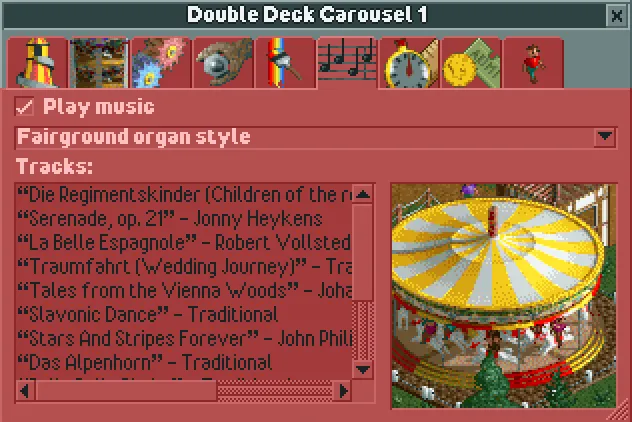
While it is a common belief that music makes your guests happier, the music on the Merry-Go-Round (either "Fairground organ style" or "Organ style") is unique in that it is the only time in the game this is actually true. However, it can only do this in very specific situations and has a very minor effect to the point where it almost doesn't exist. There are four different thoughts that consider the surroundings of the guest, and guests can only have one of those thoughts active at a time. This category also includes the thoughts of "The jumping fountains are great", "Great scenery!", and "This park is really clean and tidy". Here is the piece of coding that determines which of these thoughts the guest will get.
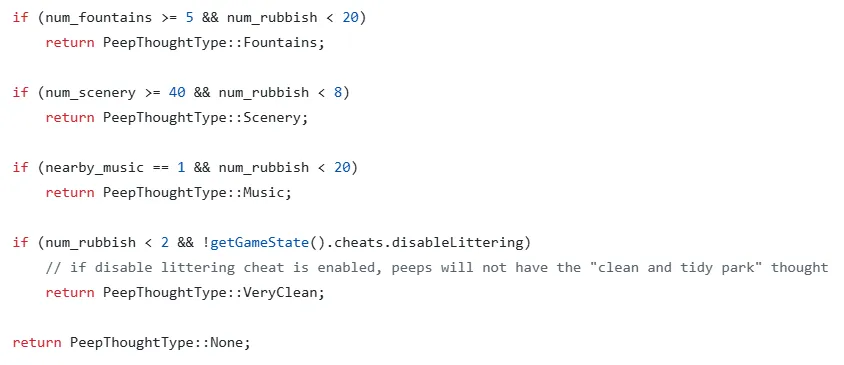
The reason the music thought is incredibly rare is because the fountains and scenery thoughts take priority. The first first checks the requirements for the thoughts about the jumping fountains. If these requirements are fulfilled, the guest will get this thought and the function stops even if they are also eligible for the other thoughts. If the jumping fountains thought isn't eligible, the game repeats this process for the scenery thought. This means that guests can only think that "The music is nice" here if they aren't already thinking "The jumping fountains are great" or "Great scenery!", which in turns means that you'd need to not have any scenery around the Merry-Go-Round or jumping fountains on the paths near it. It is also for this reason that guests might not be commenting about how clean your park is even if it's absolutely spotless since this thought is overwritten by all of the other thoughts in this category.
Normally, only the Merry-Go-Round can play either of the two eligible music tracks, but if you use cheats to play the music on other rides, the code for the music thought will still work.
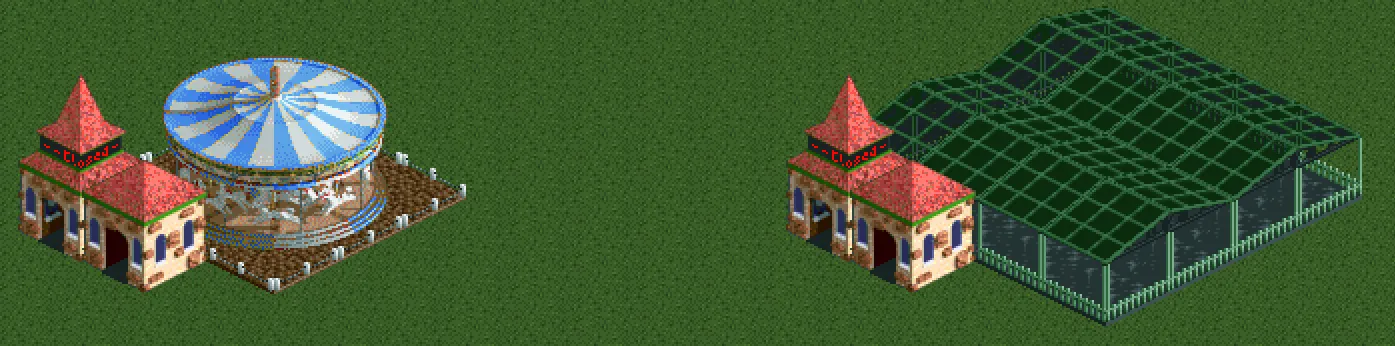
What is very weird about this is that if a Bumper Cars is close enough to whatever ride is playing "Fairground organ style" or "Organ style", guests can never get the music thought. This characteristic is tied to the Bumper Cars and not the "Dodgems beat style" music that it plays since other rides playing that music will not prevent the thought, whereas a Bumper Cars playing either of the two eligible music tracks will prevent this thought.
To reiterate, this means that guest can only experience the music thought if:
- The ride is playing "Fairground organ style" or "Organ style", which in normal gameplay is restricted to only the Merry-Go-Round.
- The ride doesn't have scenery around it.
- The paths around the ride do not have jumping fountains.
- The paths around the ride are clean and tidy.
- Any Bumper Cars close enough to the ride are not playing any music.
Stats
The stats on the Merry-Go-Round are very simple.
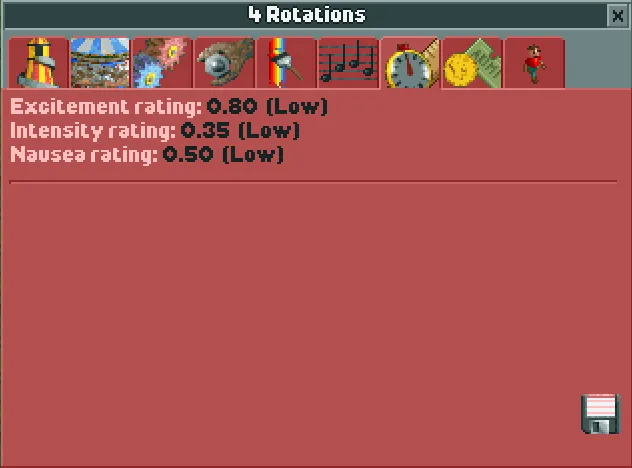
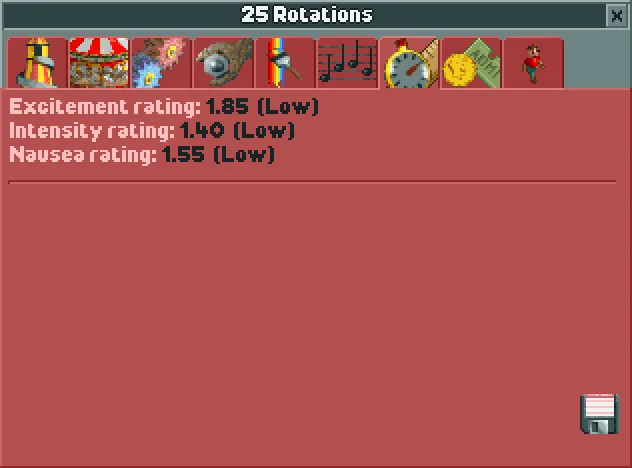
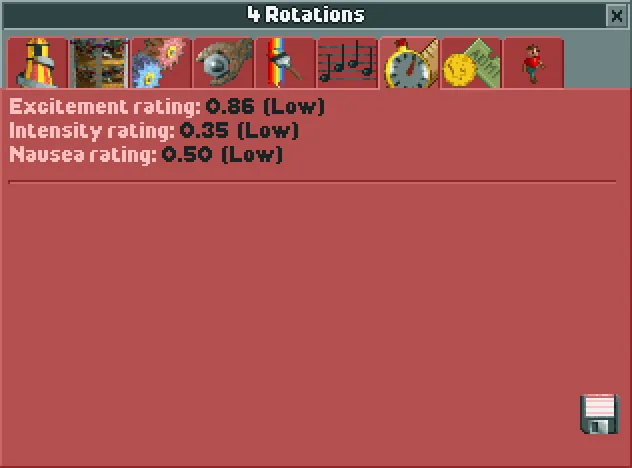
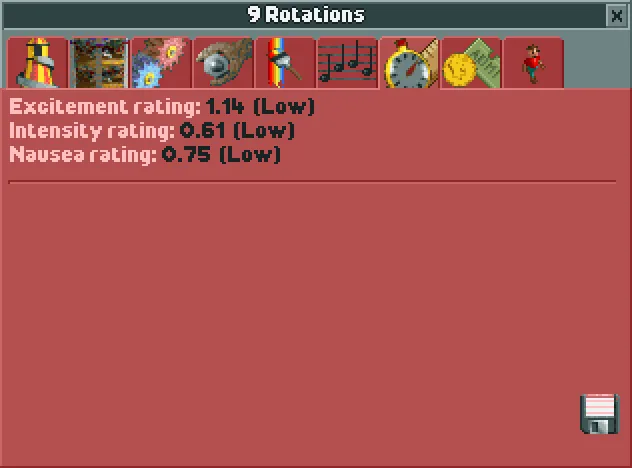
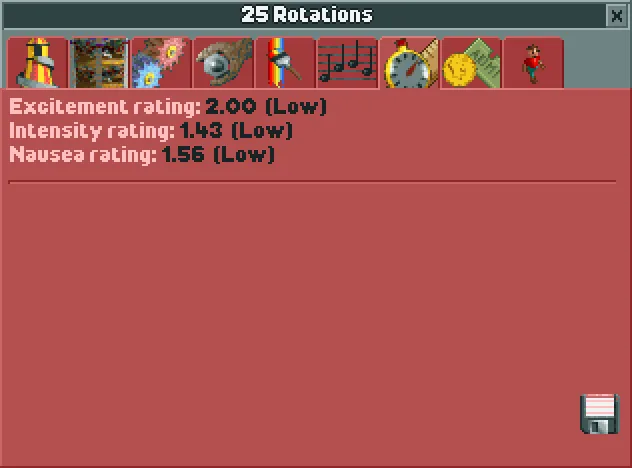
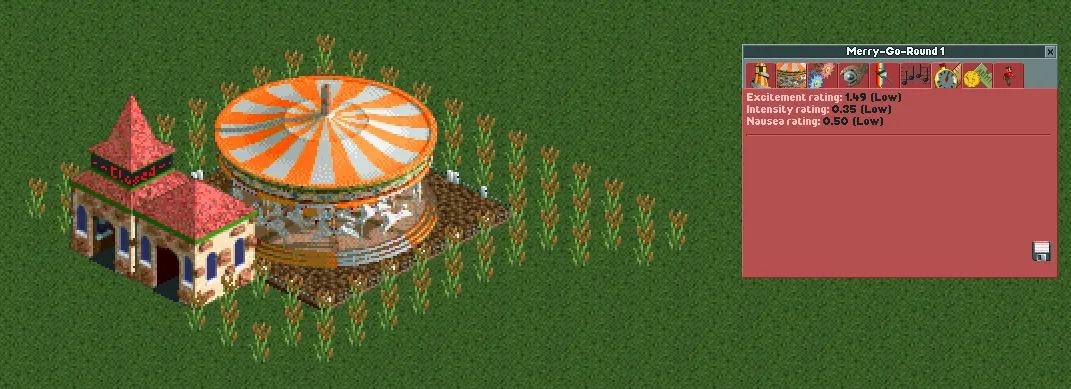
It starts with a base Excitement, Intensity, and Nausea of 0.60, 0.15, and 0.30 respectively. It then gains +0.05 to all three stats for every rotation that it does. This ties the Ferris Wheel for having the lowest base Excitement Rating in the game, and a Merry-Go-Round with 4 rotations results in an Excitement of 0.80, which is the lowest possible in the game without stat penalties.
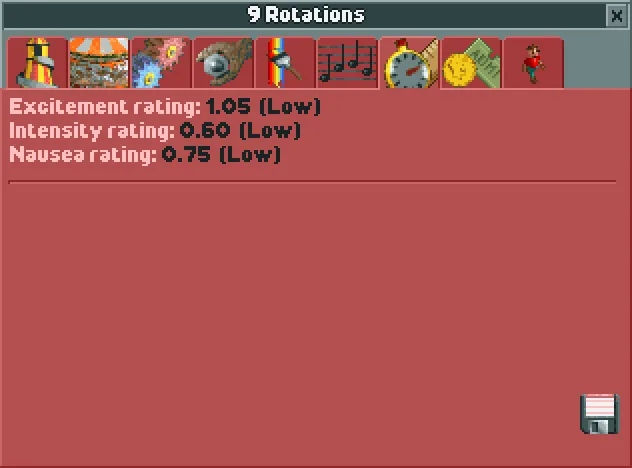
These are the base ratings of a standard variant Merry-Go-Round with 4, 9, and 25 rotations respectively:
If those Merry-Go-Rounds were Double-Deck Carousels instead, the ratings for all three rides would be the following:
Because of the tiny increase in stats and the way the Merry-Go-Rounds stat multipliers are calculated, the ticket price for any Merry-Go-Round will always stay the same if that Merry-Go-Round were a Double-Deck Carousel instead. For all intents and purposes, the only true advantage that the Double-Deck Carousel has is its extra guest capacity. This and of itself though is a big upside though.
The only other stat modifier that the ride has is a fairly big bonus to its Excitement Rating for having scenery around the park with a value of 19,521.

This value will increase the Excitement of a Merry-Go-Round by as much as 0.69 if you max out the scenery bonus while keeping the other stats untouched. This bonus will stay the same even if you change the number of rotations on the ride.
Control Failure Breakdown
A rather hilarious and beloved part of the ride is the Control Failure breakdown.
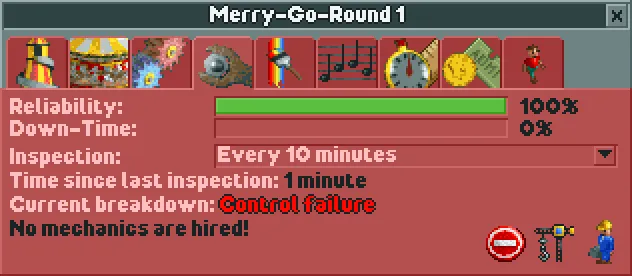
This will cause the Merry-Go-Round to start rotating faster while the music's tempo and pitch both increase. If the ride is still broken after a while, the ride will start violently shaking until it gets fixed again. There is an urban legend that a Merry-Go-Round with a Control Failure will eventually explode if it isn't fixed fast enough. This is not true, but it has become a meme among the game's community. This isn't the only myth about the Merry-Go-Round either, as there's also a common belief that placing a Merry-Go-Round near the entrance attracts more guests to the park. Once again, this is entirely false.
Guests do not become nauseous faster if they are on a Merry-Go-Round that starts to shake because of this breakdown.
Throughput & Profit
The throughput of a Merry-Go-Round is obviously dependent on the number of rotations it does. The significance of this depends on which version of the game you play. To understand the effect of this, we run the ride at the lowest number, default number, and highest number of rotations on a regular Merry-Go-Round.
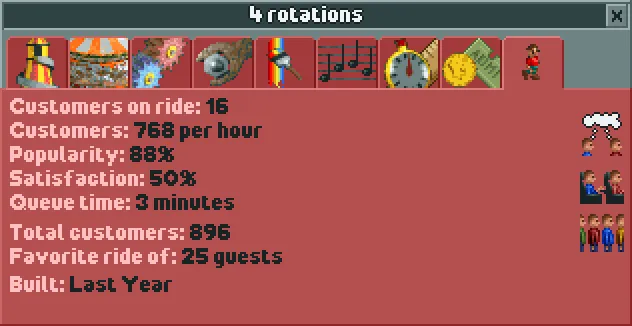
At 4 rotations, the ride has a throughput that the game fluctuates between 768 and 912 guests per hour. If we take the difference between the two numbers (144), half that number (72), then add that number onto 768, we get an average throughput of 840 guests per hour. With the ride's 5-13 month old ticket price for one in-game year, it would be priced at $0.60 in OpenRCT2, and at $2.60 in the vanilla game. This results in a total profit of $454.40 in OpenRCT2 or $2,134.40 in Vanilla RCT2.
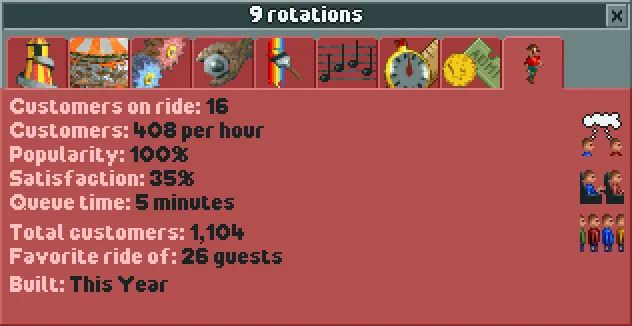
At 9 rotations, the game fluctuates between 384 and 576 guests per hour. Using the same calculations, this results in an average throughput of 480 guests per hour. With the ride's 5-13 month old ticket price, it would be priced at $1.20 in OpenRCT2, and at $3.00 in Vanilla RCT2. This gives a total profit of $526.40 in OpenRCT2 or $1,390.40 in Vanilla RCT2.
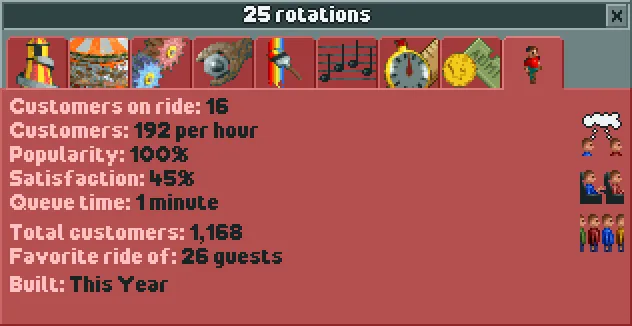
At 25 rotations, it operates at a throughput of 192 guests per hour. Because this results in the ride time being longer than how frequently the game checks the number of new riders each game has, the game will sometimes display 0 guests per hour, but once new guests get on the ride, the game will display the correct amount again the next time it makes this check. The average queue time shows up at 1 minute due to a similar quirk, but the actual time is much longer. This ride has a 5-13 month old price of $2.40 in OpenRCT2, and $4.00 in Vanilla RCT2. This results in a total profit of $411.20 in OpenRCT2 and $718.40 in Vanilla RCT2.
Despite what you might have guessed, the ride at 25 rotations has a fourth of the throughput as when it had 4 rotations despite performing six times as many rotations instead of four times as many. This is because the longer the ride, the less impactful boarding times become. Because boarding times happen less frequently and take up a smaller percentage of the overall ride time, it is able to catch up ever-so slightly.
Below is a table of the stats and throughputs of all three configurations:
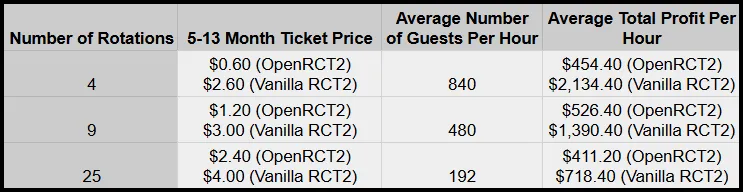
What is interesting to note here is that the average total profit per hour stays relatively similar in OpenRCT2 whilst it changes dramatically in the vanilla game. In the vanilla game, having 4 rotations is the most optimal setup, whereas the default setup is the most optimal in OpenRCT2. This makes it fairly easy to place down as you don't need to change the settings of the ride. Even in the vanilla game, you're fine leaving it at the default setup of 9 rotations unless you really want to optimize everything. Although setting it to 25 rotations won't harm your average throughput, it will harm the moods of your guests. If the queue line is long enough to support more than two full loads of guests, the guests at the back of the queue line may need to wait about 10 minutes before getting on the ride.
On a Double-Deck Carousel, the average number of guests per hour will be slightly less than double the amount of guests of a standard Merry-Go-Round for the same configuration and its profit will be about twice as much as well.
Verdict
The Merry-Go-Round is an average to slightly above-average Gentle Ride that has the benefits of rain protection and being readily available to build in most scenarios as soon as they start, making them reliable flat rides to start your parks.
Other Gentle Rides
[to come soon]
About_Author

Demonxz95 is the main "fan creation guy" on Out of Games, specializing in showcasing fan-made content from the Hearthstone community, with the occasionally unrelated article on the side. His love for card games started with Yu-Gi-Oh when he was a child and has since seen a resurgence with Hearthstone and MTG.
He can be reached through a PM on the site or on our Discord server.
More_Gentle Rides_Guides
Base Building Tips and Tricks in Palworld
A Guide to Harth Stonebrew's Iconic Hands
Latest_RollerCoaster Tycoon 2_Guides
Guide to Food and Drink Stalls in RollerCoaster Tycoon 1 and 2

Guide to Awards in RollerCoaster Tycoon 1 & 2
// join_the_conversation
Sign in to share your thoughts, vote on comments, and connect with the community.
Comments
// no_comments_found
Be the first to share your thoughts!
Leave a Comment